How hardware engineering teams evaluate DRCY
For hardware teams, design reviews are some of the most critical parts of the development process. And as any experienced engineer knows, even a small mistake can make those reviews painfully expensive. Without rigorous attention to detail, weeks of coordination between dozens of engineers across hundreds of schematic pages can quickly turn into costly respins, rework, and schedule delays.
One leading U.S. Defense Electronics Manufacturer knew all too well how small mistakes could easily slip by reviewers, especially when designing at scale. During their evaluation of DRCY, AllSpice’s AI design review agent, their team quickly saw how a first-pass AI review layer could reliably catch implementation issues before they turned into downstream program cost.
Keep reading to see how this company ran a formal controlled trial using real hardware designs and discovered how DRCY can automate tedious implementation checks that humans routinely miss.
“DRCY caught issues that had passed through our trained reviewers, including I2C flip-flops on the project we hadn’t flagged. For a program where errors mean respins, that’s the difference.” - Engineering lead, Defense Electronics
The challenge: Scaling design reviews for complex electronics
Designing for defense electronics can push processes to their limits. Modern systems often combine FPGA-heavy architectures, high-speed interfaces, and complex power sequencing into hundreds of schematic pages to comb through during a review cycle. Managing those elements at scale is where experienced engineers are most valuable: understanding system architecture, validating design intent, and reasoning about how subsystems interact under real operating conditions.
But understanding complex system architecture is only part of the battle.
As designs scale, the amount of implementation review work grows faster than human bandwidth can manage. Details like pull-up behavior, reset sequencing, IC configurations, voltage thresholds, datasheet compliance, and thousands of smaller design decisions all impact functionality. These kinds of errors are especially tricky since they can still look “correct” at a high level. The architecture may be sound. Connectivity checks might pass. The board may even partially boot. But subtle issues can still create downstream failures requiring respins and rework.
An engineering lead explained during the trial that the biggest issue for them was the sheer amount of work required to manually validate every implementation detail across an extremely large design:
“We can’t have 10 engineers spend 40 hours or 80 hours reviewing every last sheet, every last connection, every last pull-up value.” - Engineering lead
They wanted a tool that could automate the subtle, detail-oriented checks that humans are likely to overlook during large reviews. That became the role DRCY ultimately filled.
How does DRCY work alongside existing validation software?
Short answer: DRCY augments and enhances your existing workflow. No rip-and-replace required.
This was one of the biggest questions raised during the evaluation. The company already had mature validation workflows in place built around deterministic rule-checking tools. So where exactly does DRCY fit?
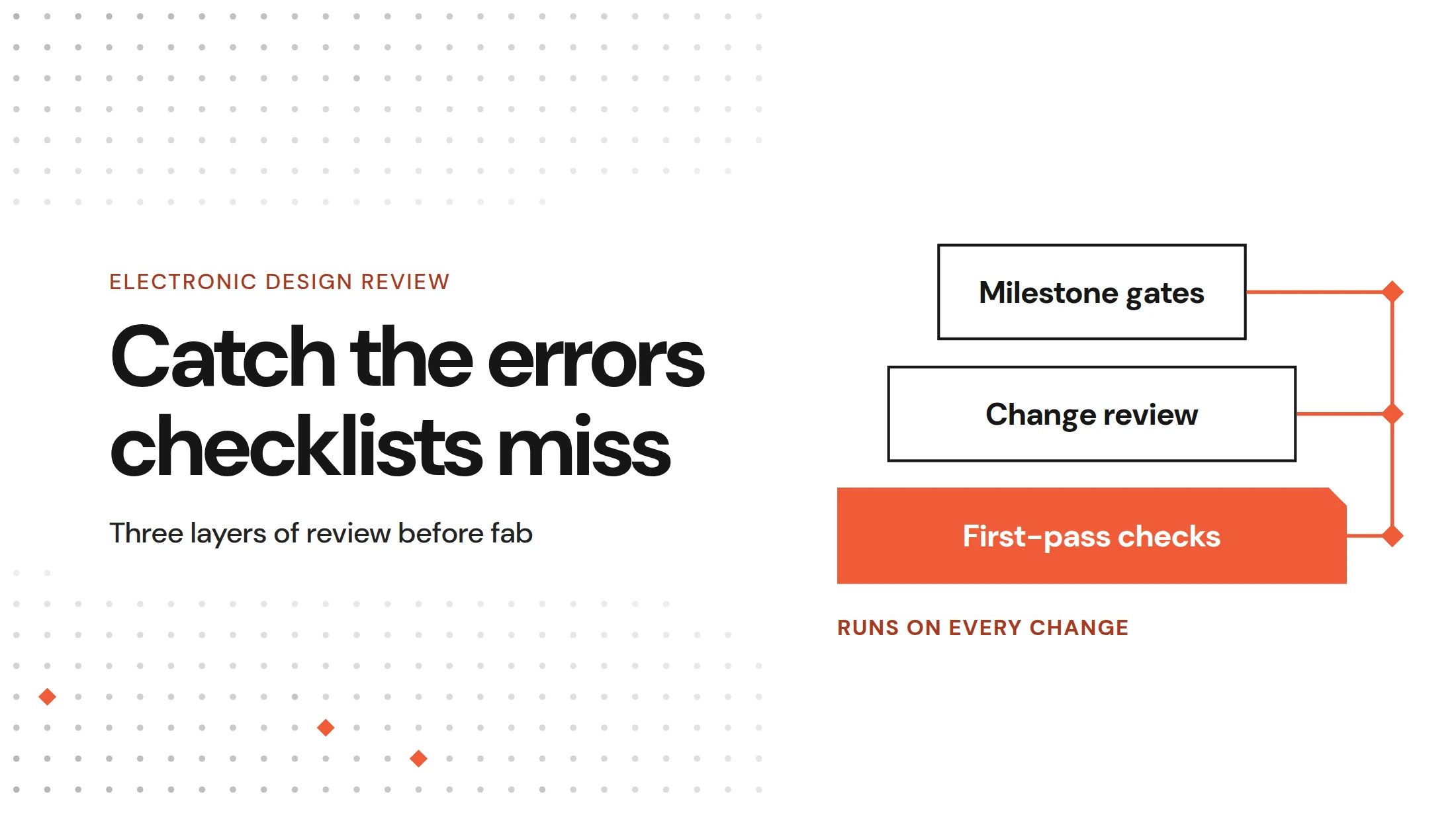
In reality, each layer of review automation serves a different purpose:
- Human reviewers understand system architecture and design intent. Engineers determine whether subsystem interactions make sense, whether tradeoffs are correct, and whether the overall system behaves the way the program requires.
- Validation software enforces deterministic electrical and design rules. It performs rule-based verification consistently at scale and validates explicit constraints that should never vary between designs.
- DRCY operates alongside those systems as a first-pass implementation review layer. It handles the context-heavy implementation checks that become difficult for humans to perform consistently.
The customer ultimately evaluated DRCY alongside their existing validation software rather than as a replacement. Their validation software remained useful for deterministic checks, while DRCY excelled at surfacing contextual implementation issues that traditional rules struggled to catch.
The trial: Controlled validation in a real engineering environment
A successful evaluation starts with a clear understanding of the customer’s challenges and the outcomes they want to achieve.
Before DRCY: A review process under pressure
Despite the eventual focus on DRCY, that was not the initial motivator for this evaluation. The original issues for the customer related to their fragmented, inefficient workflow: a disjointed combination of spreadsheets, emails, and Confluence-based design reviews. Using tools not purpose-built for engineering reviews led to significant manual effort that didn’t scale with their increasingly complex programs. They wanted a more rigorous, dedicated review framework like AllSpice that could better capture issues, discussions, resolutions, and documentation in one place.
Engineering under defense industry constraints
Further exacerbating their workflow struggles, the customer was subject to the constraints of the highly regulated defense industry.
Could their multi-tool workflow securely maintain Hardware Description Documents (HDDs) and still meet strict regulatory compliance? How would it handle Failure Mode and Effects Analysis (FMEA) against documentation requirements? What about traceability concerns? They were particularly interested in how AllSpice could centralize and potentially automate portions of this documentation process, while helping their team track the auditability and traceability metrics required for DMEA, AS9100, and IPC-1791 compliance programs.
Additionally, they needed assurance that AllSpice could handle secure deployment. Working with airgapped environments, ITAR compliance, and CUI requirements were all top of mind before the trial. Since AllSpice focuses on working closely with customers to meet their specific workflow requirements, these concerns were quickly addressed and discussions shifted towards AI capabilities with DRCY.
What success needed to look like
Rather than treating the evaluation as an informal proof of concept, clear goals were established before starting:
- Validate collaborative design review workflows: Does AllSpice have the needed functionality to streamline real engineering review processes and centralize discussions in a purpose-built environment?
- Evaluate DRCY’s ability to identify meaningful design issues: Could DRCY identify implementation issues that would otherwise consume engineering time, create downstream risk, or potentially lead to respins?
- Understand how AI fits into the customer’s engineering process: Where could AI create meaningful leverage inside an existing hardware development workflow?
To create measurable results, a formal controlled trial was conducted with DRCY using both intentionally modified schematics and real production hardware designs.
The evaluation included:
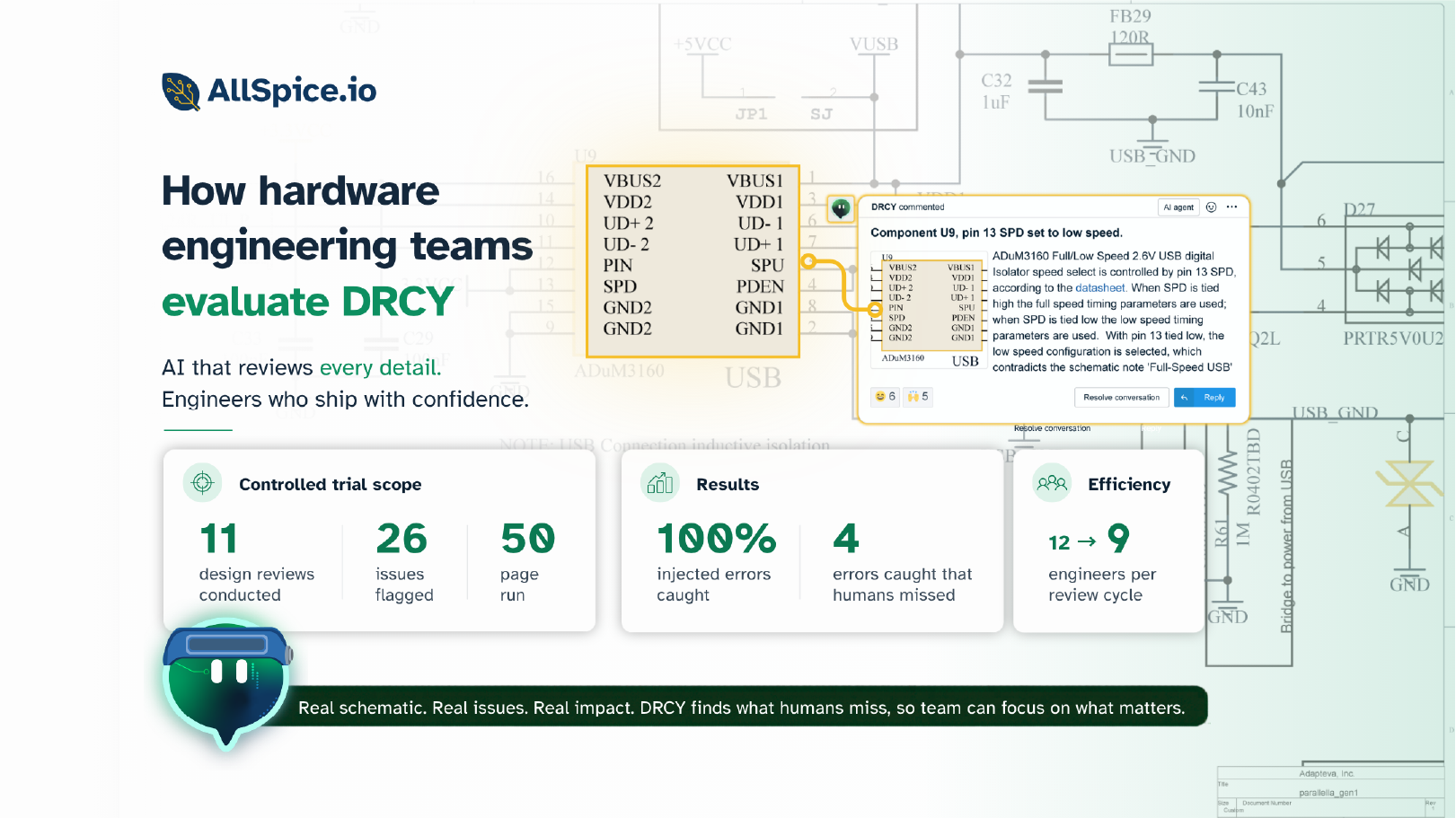
- 11 design reviews conducted with 12 engineers per review cycle
- Large FPGA-heavy and DDR5-based designs spanning up to 150 schematic pages
- Targeted 50-page review runs used to evaluate DRCY on production-scale projects
- Intentionally injected DDR5 implementation errors
This trial was intentionally structured to measure whether DRCY could identify realistic implementation problems under conditions similar to the company’s actual review process. These were not examples or isolated schematic snippets. The goal was to understand performance against the same kinds of complex designs that already strained human review bandwidth.
The results: DRCY identified errors that had already passed human review
After a two-week trial period, the conclusion was clear, and aligned closely with broader industry problems AllSpice has seen repeatedly across hardware organizations. Under schedule pressure, engineers tend to miss subtle implementation details rather than high-level architectural mistakes.
There were several meaningful outcomes for the engineering team:
- 26 issues flagged overall
- 4 legitimate design issues identified that had already passed through human review
- 100% of intentionally injected errors detected
- Successful detection of issues including:
- I2C flip-flops
- DDR5 configuration issues
- Differential sensing configuration mismatches
- IC configuration problems
- Power sequencing-related implementation mistakes
The team also projected operational improvements from using DRCY as a first-pass review layer. They estimated that automated implementation checks could reduce review staffing requirements from 12 engineers to 9 engineers per review cycle.
Equally important was the qualitative feedback from engineers throughout the evaluation. They consistently described the tool as useful, practical, and valuable enough to incorporate into their internal workflows.
One engineer described the immediate value they found using DRCY:
“I’ve been very impressed with the feedback that DRCY’s been able to provide, specifically on the first schematic that I uploaded. It caught a lot of the intentional issues that I put into the schematic” - Engineer
Proving the collaboration layer
Beyond DRCY’s impact, the customer also confirmed that AllSpice could serve as a practical collaboration layer for hardware development. Engineers operated in a significantly more structured way than their previous mix of tools allowed. Just as importantly, the team saw how AllSpice could integrate into their existing engineering process through APIs and workflow automation rather than requiring a wholesale process change.
Centralizing documentation and traceability
As a defense electronics organization, they also saw value in using AllSpice as a centralized engineering record. Design reviews, compliance documentation, release artifacts, and future-generated HDD/FMEA outputs were attached directly to the design instead of scattered across systems. That mattered significantly for meeting compliance and traceability requirements.
How customer feedback drove new features
Throughout the evaluation, the engineering team surfaced a few instances of workflow constraints and edge cases encountered while running DRCY. Instead of treating those as isolated customer requests, the AllSpice team incorporated them into core product improvements.
This rapid iteration cycle from customer feedback to implemented features reflects how AllSpice approaches enterprise adoption. By working closely with customers and their existing workflows, pain points can be identified quickly to drive solution development.
Page-level DRCY review
Some projects exceeded 150 schematic pages during the trial, meaning full DRCY runs could take hours to complete. To address that issue, AllSpice added scoped page selection to target specific ranges. This allowed the team to break up their large design into a more focused 50-page review.
Hosted datasheet service
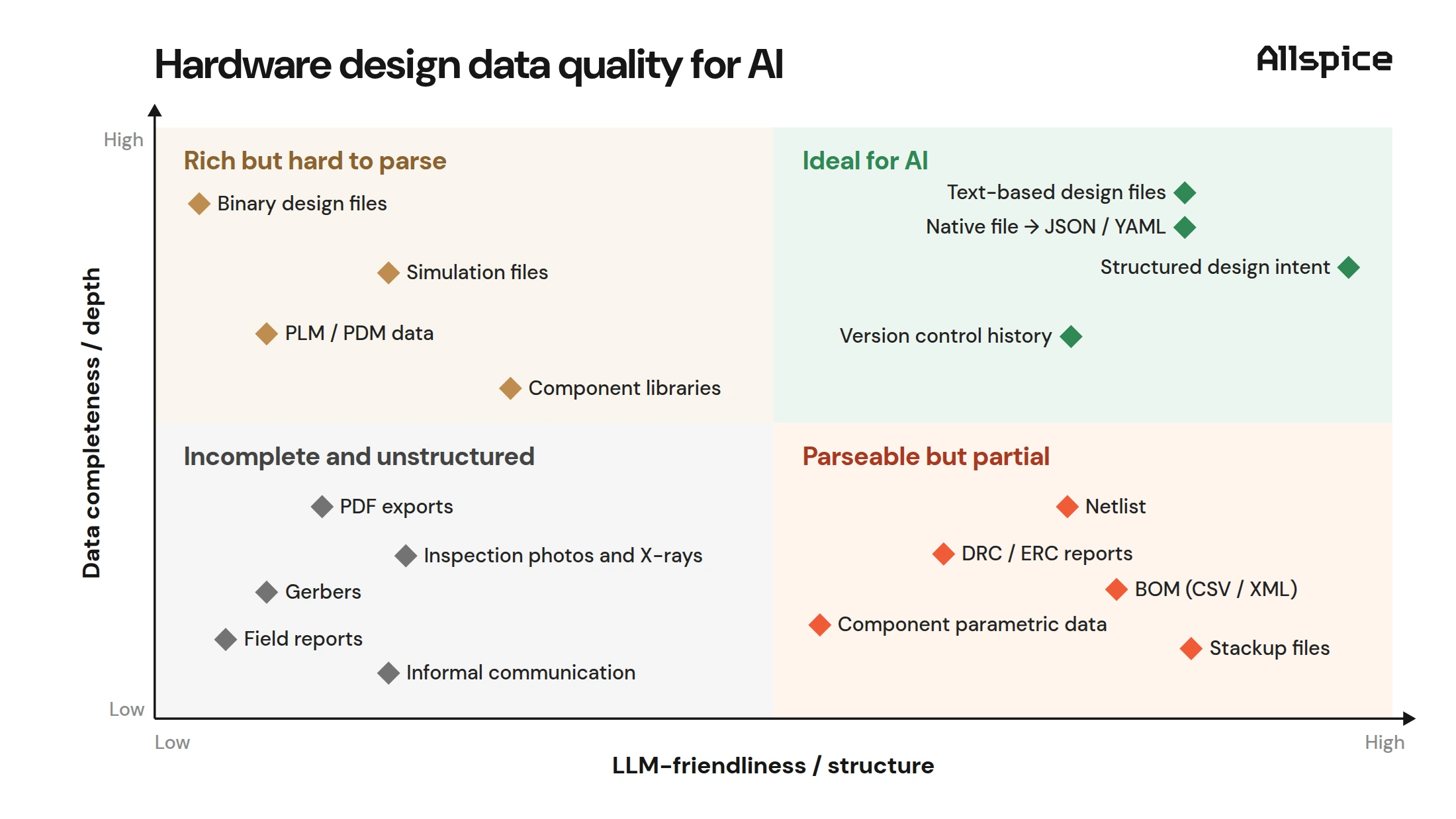
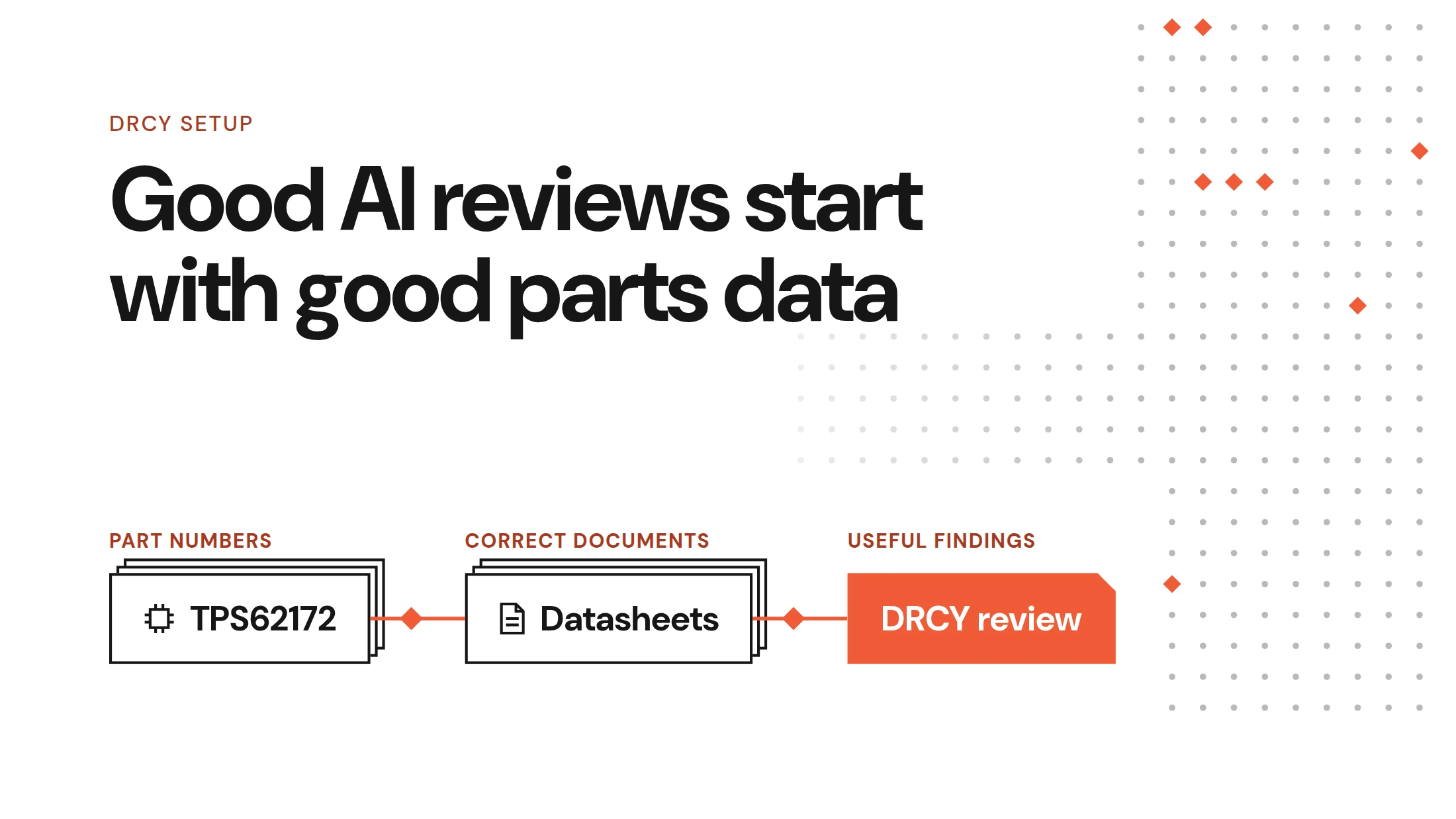
In a few situations, DRCY either interpreted datasheets incorrectly or retrieved the wrong datasheet variant for a component. Engineers quickly identified that datasheet reliability was one of the most important factors affecting review accuracy. In response, AllSpice built a dedicated hosted datasheet service designed to improve reliability by reducing dependency on external providers and enabling more consistent parsing behavior.
Variant analysis
The engineering team frequently used intentional DNP and configuration-specific design variants. DRCY occasionally flagged these as false positives due to lack of contextual awareness for those situations. That feedback directly impacted AllSpice’s development roadmap. Variant-aware support is currently being prioritized to help DRCY distinguish between intentional configuration differences and genuine implementation mistakes.
Key takeaways for hardware teams
The trial reinforced several important realities about AI adoption in hardware engineering:
- The most valuable AI workflows augment rather than replace: For the customer, human architectural validation, deterministic rule enforcement, and AI-first implementation review worked best together
- Deployment timing matters: The engineering team noted that DRCY would have delivered even more value earlier in the design lifecycle, before any large human review cycles had occurred
- Enterprise teams need adaptable tooling: Customer feedback from the trial directly shaped new features built to handle operational challenges
- AI value scales with complexity: The largest and most complex designs produced the clearest value from DRCY, where implementation review workload exceeded practical human bandwidth
The future of hardware design is not fully autonomous. Large-scale hardware programs are too complex, too contextual, and too dependent on human architectural judgement for engineers to be removed from the process entirely. What this trial demonstrated instead is the value of a layered review approach for scaling hardware designs without sacrificing review quality.