"Just get me there faster": How quick review was built
“This is great — just get me here faster.”
— Electrical engineer at a Fortune 100 consumer electronics company
You’ve probably said this once or twice before while testing out new software. Getting to that critical step in your design workflow took how many steps?
Most engineers have probably normalized this kind of inefficiency. Clunky workflows. Setup processes with too many steps. Review cycles involving unnecessary manual work. Over time, teams adapt around the friction instead of questioning whether the workflow itself should be simpler in the first place.
At AllSpice, one of our core product philosophies is to stay close to our customers to see these kinds of workflow issues directly and work quickly to implement new solutions to address them.
The Quick Review feature recently emerged from this type of rapid customer feedback loop. One of our enterprise customers highlighted issues with how AllSpice fit into their existing workflow. Their team was interested in collaborative design reviews, especially the visual diff capability, but they already had an established version control system in place. They were looking for a solution that could standardize their design review process without replacing their broader infrastructure.
In this blog, we’ll explain how Quick Review was developed in response to that customer feedback, and how AllSpice works closely with customers to identify problems, quickly develop new solutions, and implement them as features.
.png)
Quick Review is a lightweight hardware review workflow in AllSpice that enables fast collaborative PCB reviews and visual diffs without full repository setup
How we discovered the problem
During onboarding conversations with this enterprise customer, we received some key feedback about their experience getting to collaborative design reviews and visual diffs:
- “Usability is key for us”
- “I could learn this tool, but I likely won’t”
- “Get me to this page faster”
The value of AllSpice was apparent for them, but with limited time (they ran design reviews twice daily) and other competing tools in their workflow, getting to the core functionality quickly was essential.
This insight initiated development of Quick Review to reduce setup friction.
The existing workflow model
To understand the context behind Quick Review, let’s look at a typical process in AllSpice for repository setup and first design review:
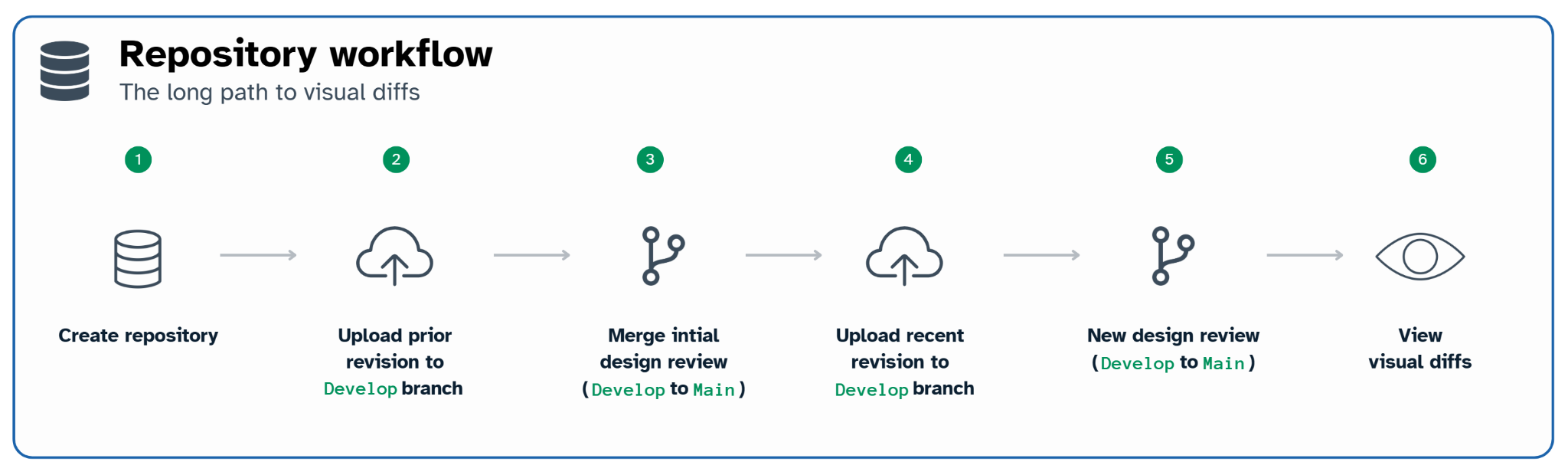
With a full repository-based setup, teams can:
- Track complete version history across the entire project lifecycle
- Integrate directly with ECAD tools and source-control systems tied to production development
- Automate reviews, actions, and engineering processes across connected systems
- Maintain persistent collaborative review infrastructure as projects and teams scale
Utilizing this data infrastructure model is the core of the AllSpice framework.
These capabilities resonate strongly with engineers. Being able to compare hardware revisions visually, comment directly on changes, collaborate asynchronously, and run AI-powered design reviews solve real engineering problems immediately. But when users report friction during onboarding, it’s important to discover where the disconnect is.
Value doesn’t always mean adoption
However, not every customer needs the full breadth of AllSpice’s capability right away. Some teams:
- Already have established version control systems in place
- Only need lightweight review capabilities during evaluation or specific review cycles
- Want to compare two hardware revisions visually and gather feedback quickly without restructuring their broader workflow
- Are still onboarding in Levels 1-2 of rolling out AllSpice but want certain functionality immediately
Reducing onboarding friction has effects beyond simplifying a single workflow. A faster path into collaborative review has the potential to expose more users to the core value of AllSpice earlier in the rollout process.
How we developed the solution
Internally, the product development process followed a version of the Double Diamond Model. This model describes 4 stages for exploring an issue widely, then taking focused action:
- Discover: Expand the problem space. Understand the broader context and surrounding workflow instead of responding to isolated feature requests.
- Define: Narrow down the core friction point and prioritize solving that first. As patterns emerge, the problem becomes more clearly defined.
- Develop: Explore multiple solution approaches. The goal is to evaluate multiple ways to reduce friction while preserving the integrity of the larger framework.
- Deliver: Converge on the simplest workflow capable of delivering meaningful value quickly.
In practice, the critical part is proximity to customers. Putting real hardware development processes into context to create appropriate solutions requires a hands-on approach.
For Quick Review, our product managers were not operating through multiple layers of support abstraction or relying on vague feature request forms. They were working directly in onboarding sessions, developing and reviewing user journey maps, listening to customer calls, and iterating alongside engineers in real time. That proximity to customers led to a clear understanding of the actual constraint.
Prioritizing development efforts
Determining which feature development project should take priority is less about rigid roadmap schedules and more about identifying which operational constraints are preventing customers from reaching value. Our product team is intentional about evaluating which problems, when solved, can have the broadest impact on user experience.
Quick Review was implemented rapidly because the underlying issue affected onboarding, evaluations, enterprise adoption, customer retention, and DRCY (our design review AI agent) workflows simultaneously. Rather than solving a narrow edge case, it removed a bottleneck preventing users from reaching the core collaboration experience itself.
How we implemented it
Implementation focused on translating earlier product development work into a Minimum Viable Product (MVP), allowing the team to validate learning during iterative testing.
The Quick Review workflow model
To create a more accessible path into core collaboration and visual diff, Quick Review simplified the onboarding progression dramatically:
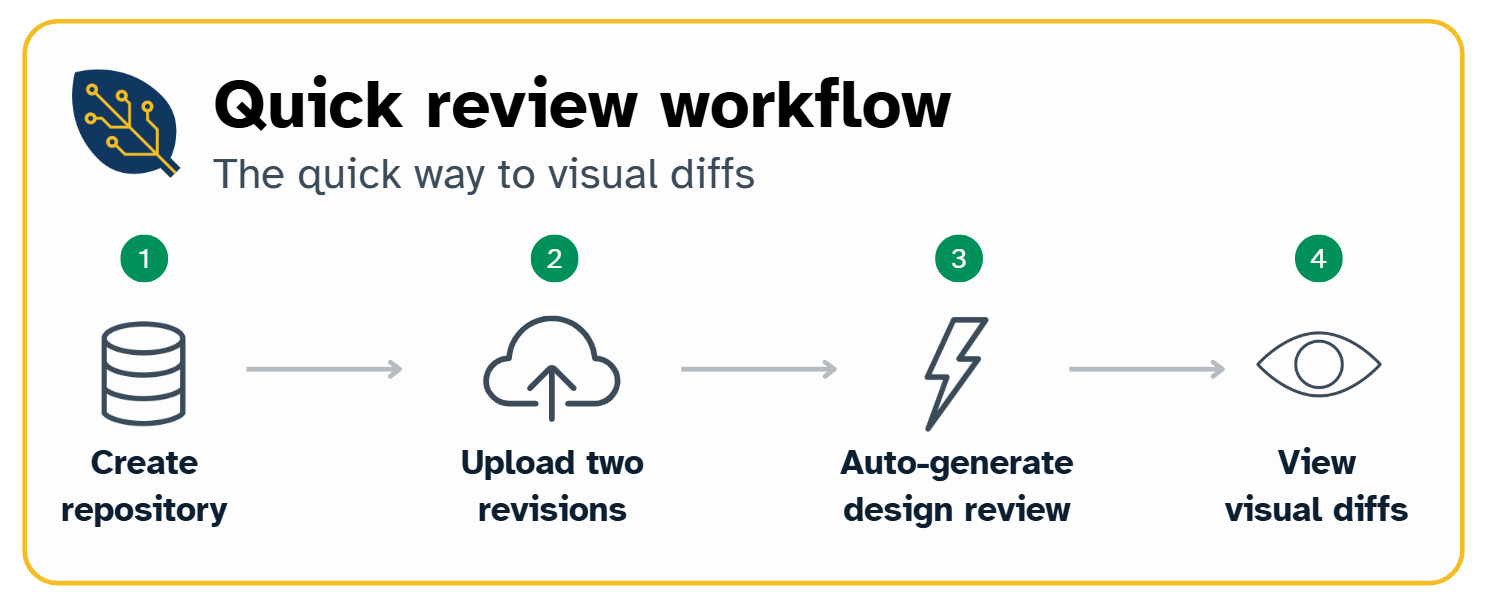
Instead of requiring users to understand branching workflows and follow repository setup procedure, the system reduced the process to a much simpler interaction:
- Create a new repository
- Upload two revisions directly
- Automatically generate a design review
- Immediately see visual diffs
Adoption and impact
Quick Review produced immediate impact for new users:
- 75% reduction in workflow complexity: Reduced the process for creating a design review from 36 steps to 9
- 30% faster onboarding to first value: Average time for new organizations to open their first design review dropped from 8.8 days to 6.2 days in the quarter after the feature was introduced
The Fortune 100 consumer electronics company referenced earlier saw a 200% increase in paid Committer seats within 6 months. They experienced broad adoption across their organization as users gained easier access to collaborative review
Most importantly, Quick Review reinforced our commitment to meet teams where they already are. Some organizations eventually move into deeper repository workflows and automations. Others primarily need lightweight review capabilities during evaluations or focused review cycles. AllSpice supports multiple paths for adoption as customers move towards their organizational goals.
From feedback to deployment in days
One of the more notable parts of the Quick Review story is how quickly the feature moved from feedback to deployment. Roughly a week after initial customer conversations, the team had built and deployed an early version of the feature for evaluation.
That speed mattered for two reasons:
- It allowed the team to validate the workflow directly with customers instead of spending months discussing hypothetical solutions internally
- It gave customers visibility into how their feedback was shaping the product in real time
By using a quick rollout approach, initial delivery is treated as the beginning of the feedback cycle rather than the end of development. Early implementation allows rapid feedback cycles before broader release. Instead of waiting for a perfectly finalized system, the team prioritizes getting a functional workflow into real engineering environments quickly and iterating based on actual usage patterns.
What we learned
Several themes emerged repeatedly throughout the Quick Review development process:
- Listen closely to operational friction, not just feature requests
- Meet hardware teams where their existing workflows already are
- Reduce time-to-value aggressively during onboarding
- Prioritize usability over exposing every capability immediately
- Ship quickly enough to validate workflows with real users
- Treat iteration as part of delivery, not something that happens afterward
Time-to-value is especially important in hardware development. Engineering environments are already fragmented across ECAD tools, PLM systems, review processes, documentation systems, and manufacturing constraints. Every additional layer of workflow complexity carries a real adoption cost, and reducing friction early creates space for deeper workflow integration later.
Quick Review ultimately represents more than a simplified upload flow. It reflects a broader philosophy around how AllSpice believes that engineering infrastructure should evolve alongside customer workflows.