Bringing AI into hardware design reviews

Where hardware teams are today
Despite working on some of the most sophisticated technology in the world, many hardware engineers still rely on spreadsheets, tribal knowledge, and sometimes quite literally pen, paper, and a highlighter.
Delivering new hardware products on schedule often comes down to finding a needle in a haystack you don’t even know you’re looking for. The spec buried deep in a 900-page datasheet.
We know, because we’ve been there.
That's why, from day one, we’ve set out to automate the repeatable parts of hardware design: the well-defined, rules-based tasks that make sure nothing gets missed and everything lines up. That’s the kind of work technology is well suited for.
Introducing DRCY
Engineers shine in system-level design, informed judgment, and creative problem solving. In an ideal workflow, they spend their time on the decisions that shape the product, while technology handles the rest.
This is where DRCY comes in. DRCY is an AI-powered agent built specifically for hardware design reviews. It parses datasheets at scale and runs first-pass checks for compatibility and fundamental design issues, surfacing potential risks and pointing reviewers to where their attention matters most. Issues surface early, during reviews, when fixes are still fast and contained.
How DRCY reasons
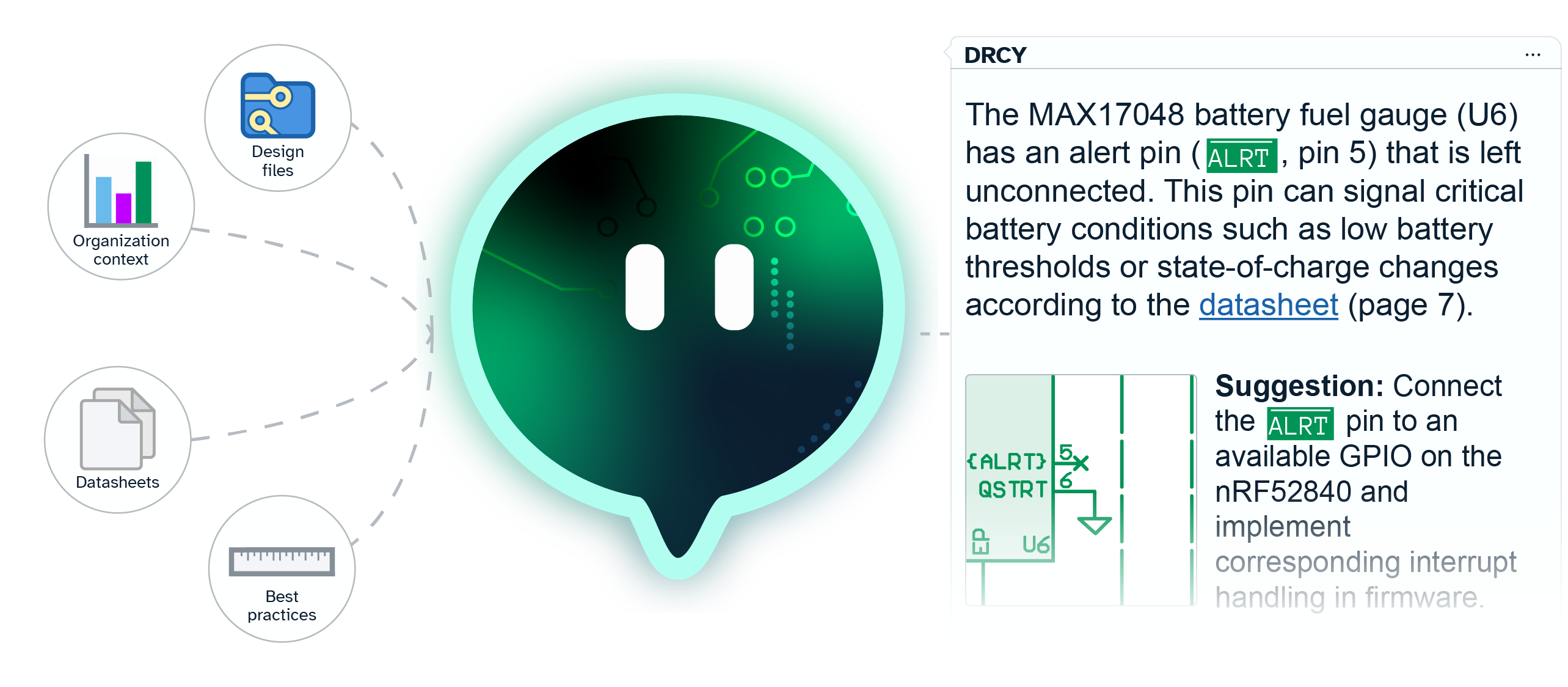
DRCY combines foundational engineering knowledge with dynamically gathered context at runtime, rather than training on customer designs.
Four key ingredients power DRCY:
Designs. Schematics, PCBs, and libraries converted in AllSpice into a text-based representation AI can interpret accurately, avoiding the hallucinations introduced by PDFs and image OCR from general-purpose AI tools.
Organizational context. Prior reviews, comments, documentations, lessons learned, and design guidelines in AllSpice inform how DRCY evaluates new changes.
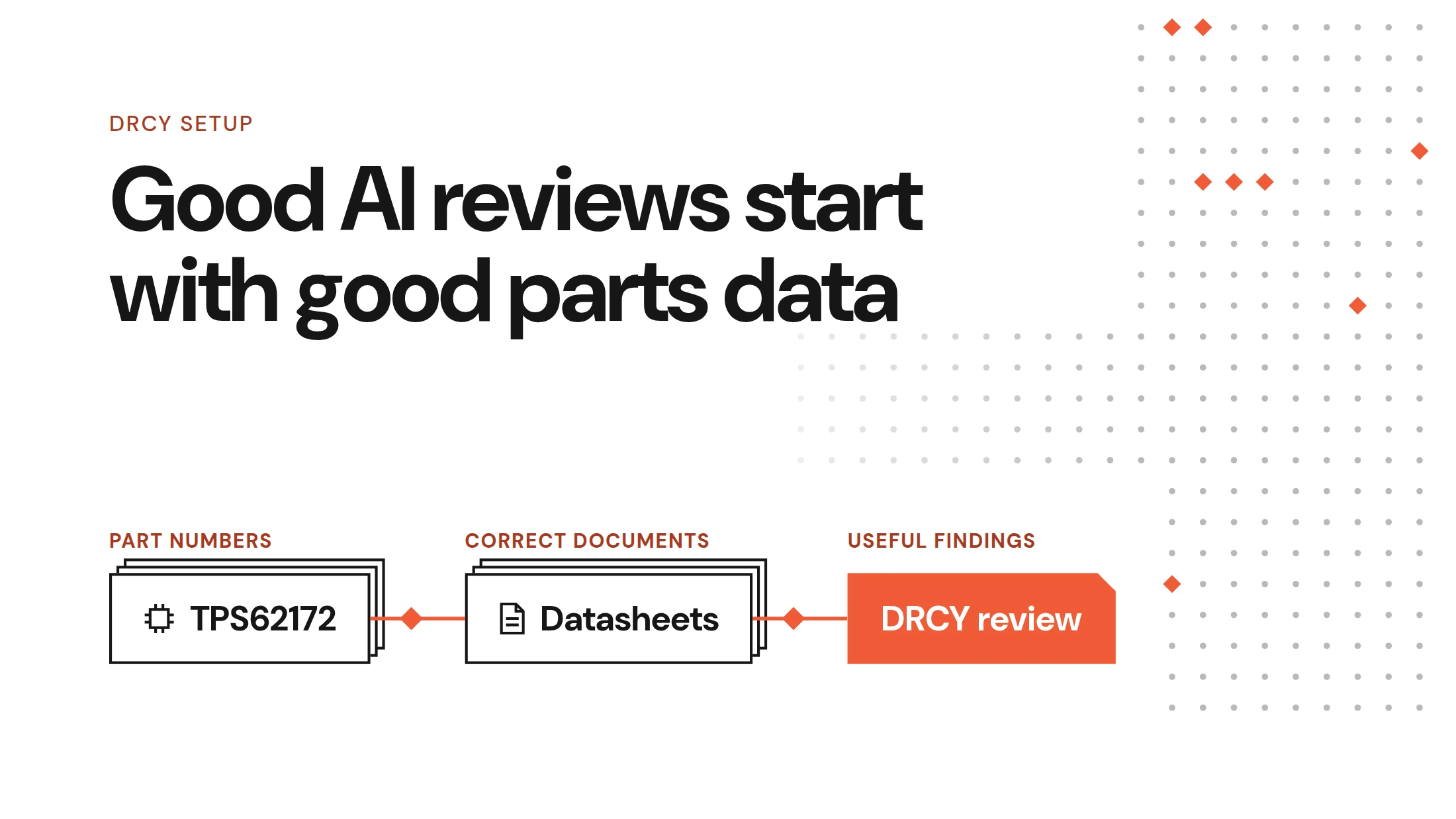
Datasheets. DRCY fetches and parses component datasheets and reference drawings, including proprietary documents you choose to provide.
AllSpice knowledge base. A continuously improving knowledge layer guides DRCY on best practices for electronics design and review.
What DRCY looks for
With access to designs, datasheets, and organizational context, DRCY handles repeatable, first-pass checks at scale. It validates documented constraints, cross-references components, and surfaces potential issues early, directly inside existing workflows.
In practice, DRCY looks for common but costly design issues, including:
- Incorrect voltage references for IC pins
- Pins operating outside specified voltage or current limits
- Swapped signals such as TX/RX, SDA/SCL, or USB differential pairs
- Incorrect component packages
- Reverse-polarity passive components
- Mismatched voltage domains or insufficient pin drive strength
- Reset circuitry issues
- And more
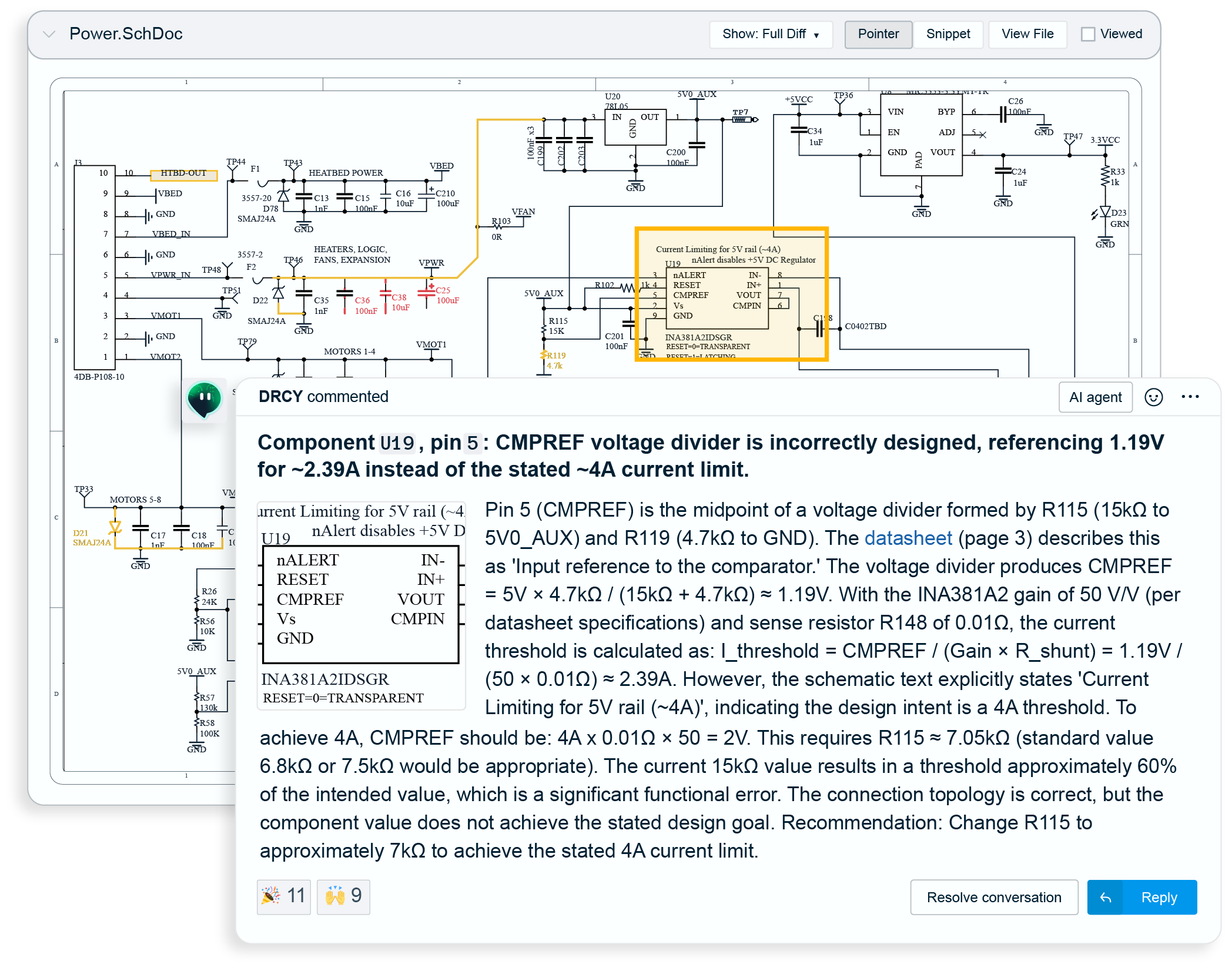
Consider a common scenario. A contract manufacturer notifies your team that a component is end-of-life. To keep production moving, you need a replacement quickly. The team selects a substitute, but the substitute component has different reference voltage on one of the pins, completely breaking compatibility.
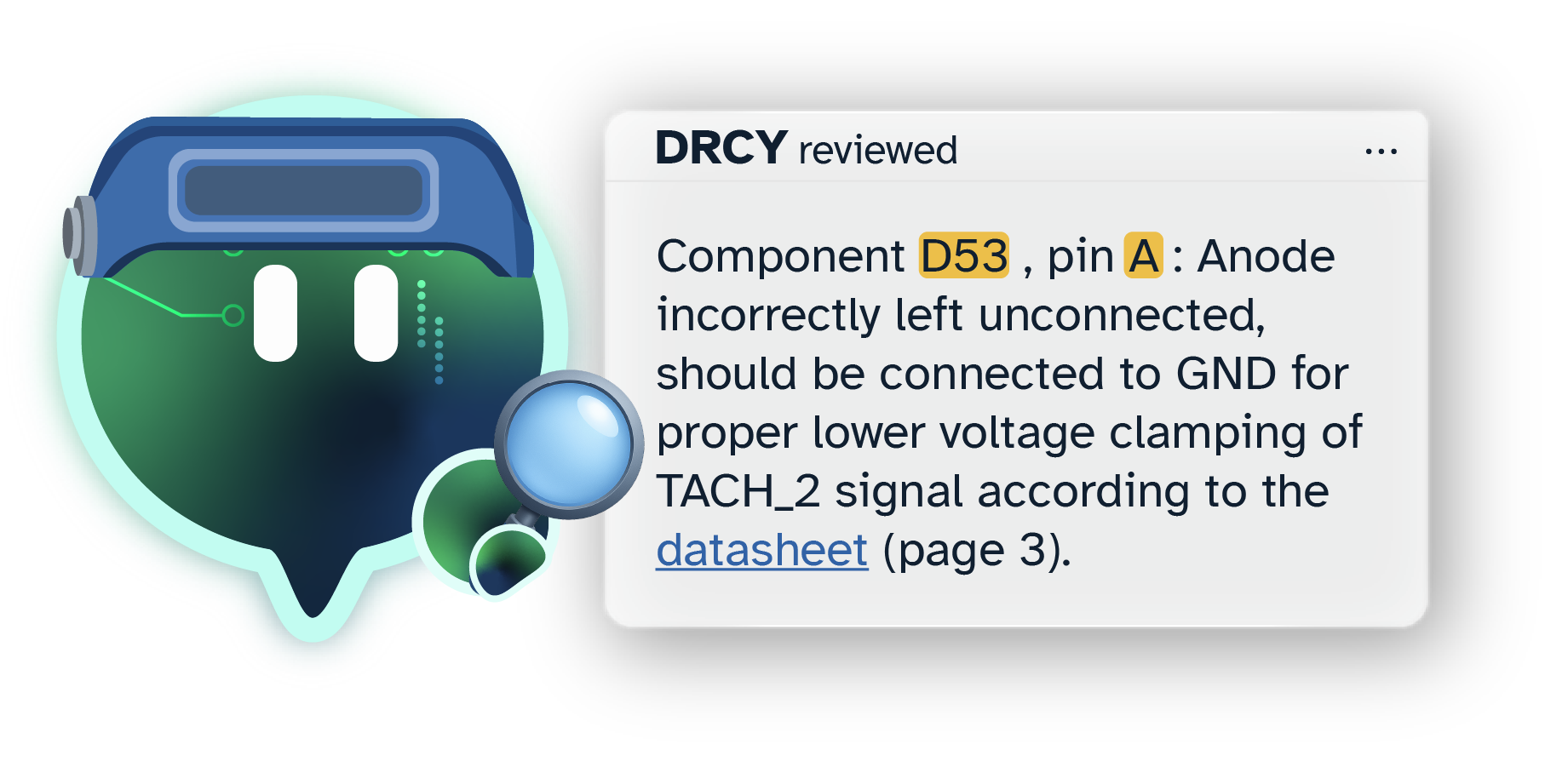
DRCY cross-references the datasheet and flags the issue for engineering review before the design moves forward. No re-spins. No production delays. No late-stage surprises.
This is the broader shift DRCY enables. Instead of reacting to errors after designs are sent to production, teams gain continuous, lightweight insight from the earliest stages of the design process.
Keeping engineers in the loop
DRCY is designed to support engineering judgment, not replace it. It surfaces risks, flags inconsistencies, and points directly to the source documentation behind each finding.
Engineers have clear visibility into why an issue was raised and the data it’s based on. Every finding is traceable, grounded in datasheets, specs, and reference designs.
Feedback appears directly in the design, with full context, so resolving issues is straightforward. Engineers stay in control, with the confidence that comes from AI that shows its work.
Bringing AI into production workflows
Today, AllSpice supports thousands of engineers across Fortune 50 companies, hyperscalers, and some of the most innovative teams in the world.
With DRCY, teams can change designs with confidence and make the RIGHT choice, not just the safe bet. It reduces uncertainty without slowing momentum, raises the quality bar without increasing headcount, and gives engineers the freedom to innovate.
We believe the future of hardware belongs to teams that stay focused on what really matters: design excellence, development speed, and advancing frontier technology.
If you’re designing hardware that pushes limits, we’d love to build alongside you.
- Valentina & Kyle