Two questions every hardware leader should answer before approving AI tools
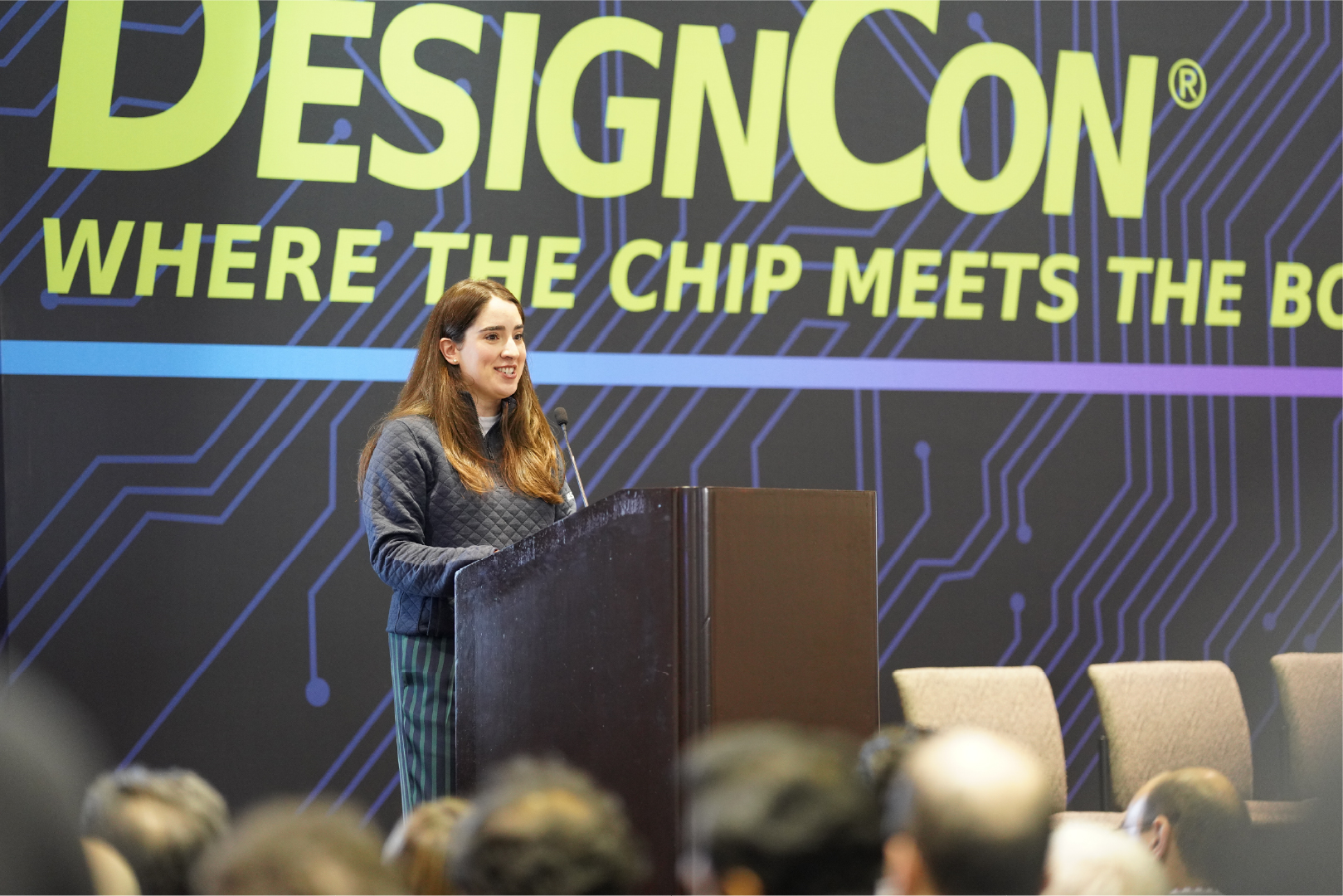
At DesignCon this year, our CEO Valentina walked through how AllSpice thinks about AI tooling for hardware development. The talk covered eight specific opportunity areas where AI can move the needle, but the pattern we've seen working with Fortune 500 teams comes down to two questions. The companies getting results have answered both. The ones stuck in pilot hell haven't answered either.
Every hardware engineering leader seems to have been asked to evaluate AI tools. Vendors are promising everything. We built DRCY, our AI agent for schematic review, because we kept seeing teams waste weeks on evaluations that were set up to fail. The technology wasn't the problem. They hadn't figured out if AI was the right tool in the first place.
Here are the two questions we’d ask before you approve anything.
1. Is this actually a job for AI?
AI is a specialized tool. It does specific kinds of work well and other kinds badly. The mistake most teams make is assuming any hardware workflow is an AI workflow, then getting frustrated when a probabilistic system fails to behave like a deterministic one.
The core distinction: deterministic systems enforce rules. You write the check with clear criteria and get the same answer every time. This is where compliance, change control, repeatable workflows, and known-problems-with-known-solutions live. AllSpice Automations handle that layer. Take a concrete example: flagging components that are end of life. That’s a deterministic question. You check the manufacturer part number against a database, and you get a yes or no.
AI is probabilistic by definition. A large language model will give you slightly different answers to the same question, three times in a row.
What AI is genuinely good at: interpreting ambiguity, surfacing insights from complex data, parsing thousands of pages of datasheets faster than any human could, catching subtle issues that rule-based checks can’t anticipate. It acts as a force multiplier, not a replacement for engineering judgment. If you want 100% accuracy on the same input every time, you probably shouldn’t be using AI at all. Use a deterministic system.
The best teams understand this. They don’t pick one or the other. They pick the right tool for the right job, and they use both.
2. Do you have the data foundation to get value from AI?
Our CTO Kyle puts it bluntly: garbage in, garbage out. AI is only as good as the data it operates on. In most hardware organizations, the data is not in shape.
When we look at what separates teams that get value from AI from teams that don’t, it comes down to four data categories.
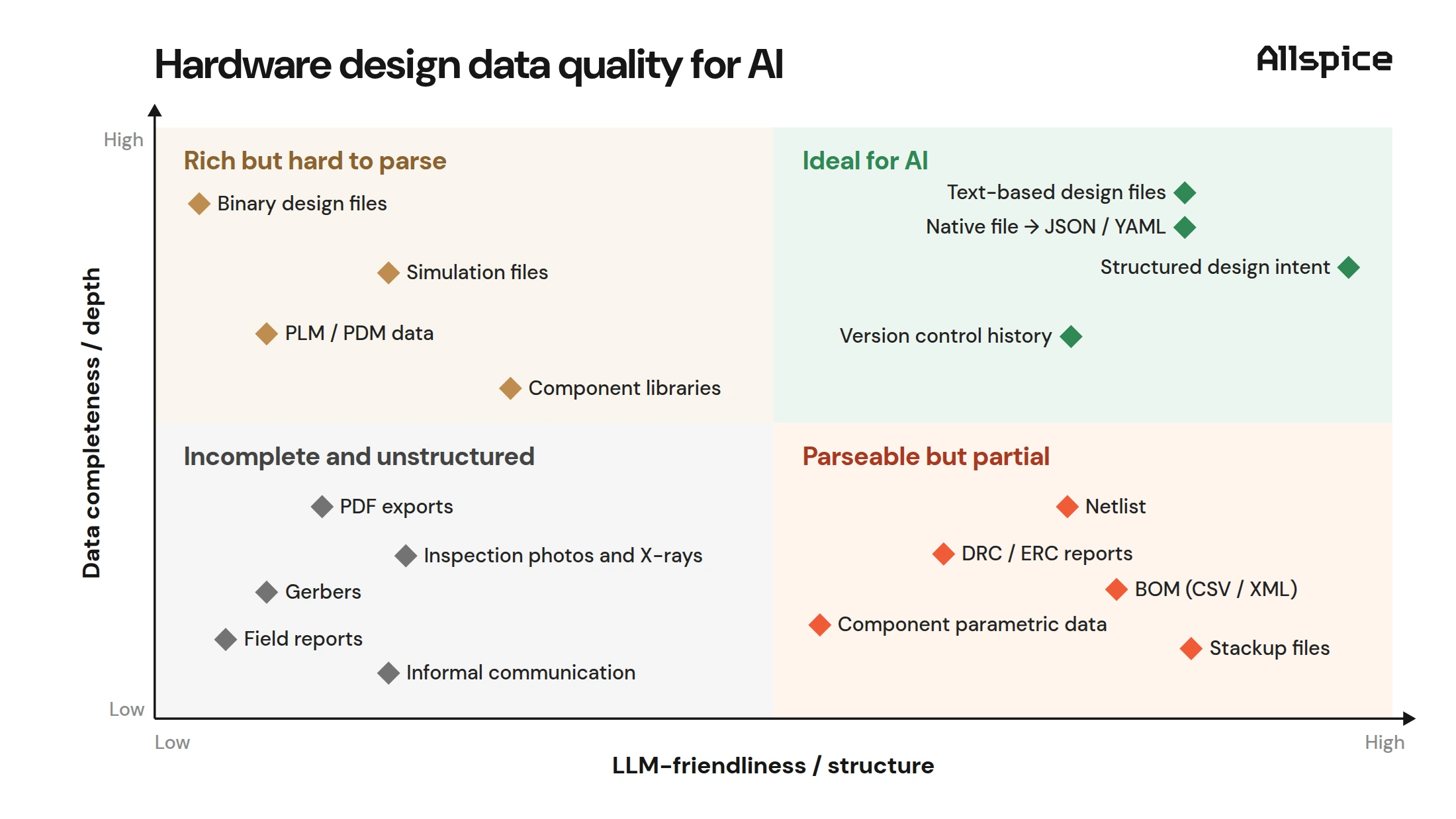
Design information. Schematics, layouts, and BOMs. There are different levels of fidelity here. A PDF export of a schematic is not the same as the native design file. The PDF contains maybe 20–30% of the information in the original. The rest, including net names, component metadata, hierarchy, and connectivity, is discarded the moment you render. Worse, PDFs and images are where LLM hallucinations come from. Based on our benchmark testing, 70–80% of hallucinations we see in hardware AI come from PDFs and screenshots. If you’re serious about AI for hardware, you need your design data in a structured, machine-readable form.
Institutional memory. Roughly 80% of what an engineer knows about a design doesn’t come from the datasheet. It comes from lab time and from the senior engineer who remembers why that topology was chosen two revisions ago. Historically, this knowledge has lived in email threads, Slack messages, whiteboard photos, and people’s heads. When engineers leave, most of it walks out the door with them. AI makes capturing this knowledge urgent. Design reviews that happen in a structured system, rather than a conference room, create a retrievable record of approvals and rejections, with reasoning attached to each. Every one of those decisions becomes context for future reviews.
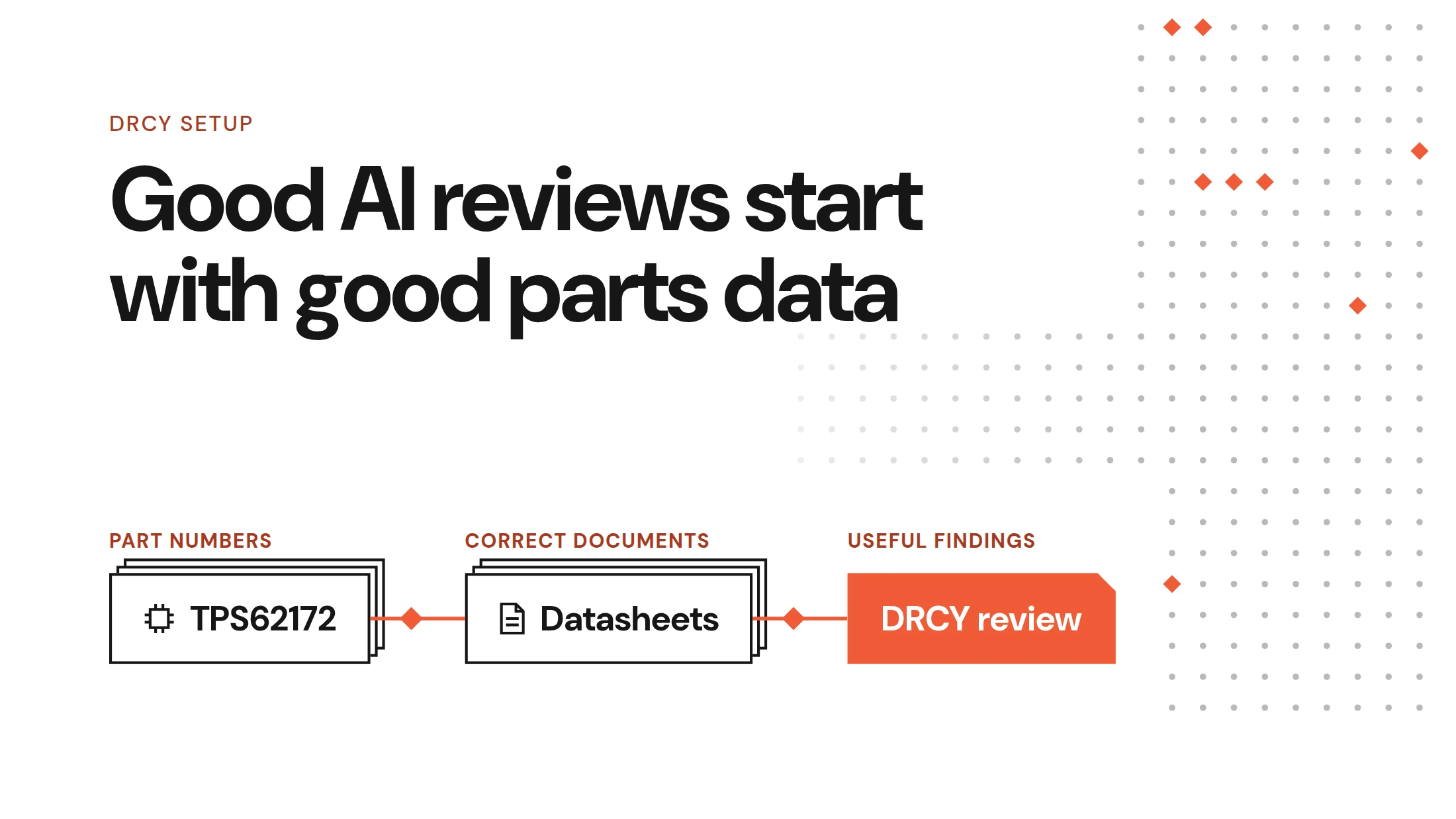
External intelligence. Datasheets and component libraries. The devil is in the long tail. Off-the-shelf parts are easy. Proprietary datasheets, internal component libraries, and custom-negotiated NDA’d specs are where AI tools trip up. If 20% of your BOM is non-standard, and your AI can’t access those specs, you’ve got 20% of your design flying blind.
Logic and standards. The rules themselves, plus the rationale behind them. An aerospace company optimizing for weight has different right answers than one optimizing for cost. The component that’s correct in one context is wrong in another. AI thrives when it has your standards and review logic as structured context, not when it’s guessing from a generic base of public information.
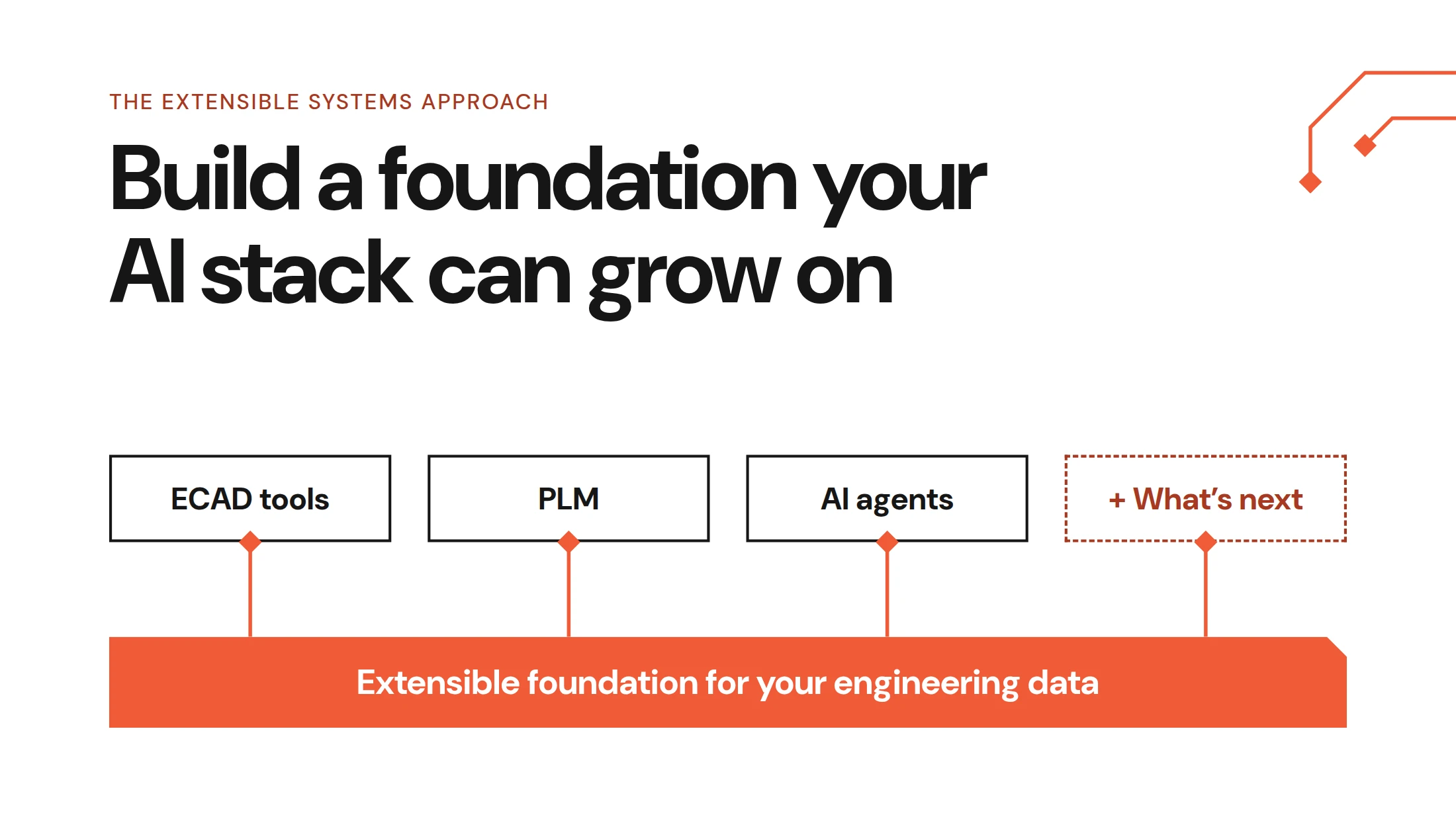
None of this is theoretical. The Apple hardware team is one of the most sophisticated in the world, and the first thing they talk to us about is data infrastructure. They understand that no model is going to outperform the quality of what it’s given.
Where to start
The teams that succeed with AI in hardware pick one workflow and prove value before they scale. Start with one motivated team and a measurable outcome.
We put together a briefing that covers this in depth: eight specific opportunity areas for AI in hardware development, where deterministic systems are still the better tool, a quantified ROI case from an example Fortune 500 hardware company running 250 releases a year, and a five-phase rollout framework for getting from evaluation to org-wide deployment without a disruptive, big-bang rollout.
If you’re the person who owns this decision, it’s worth a read.