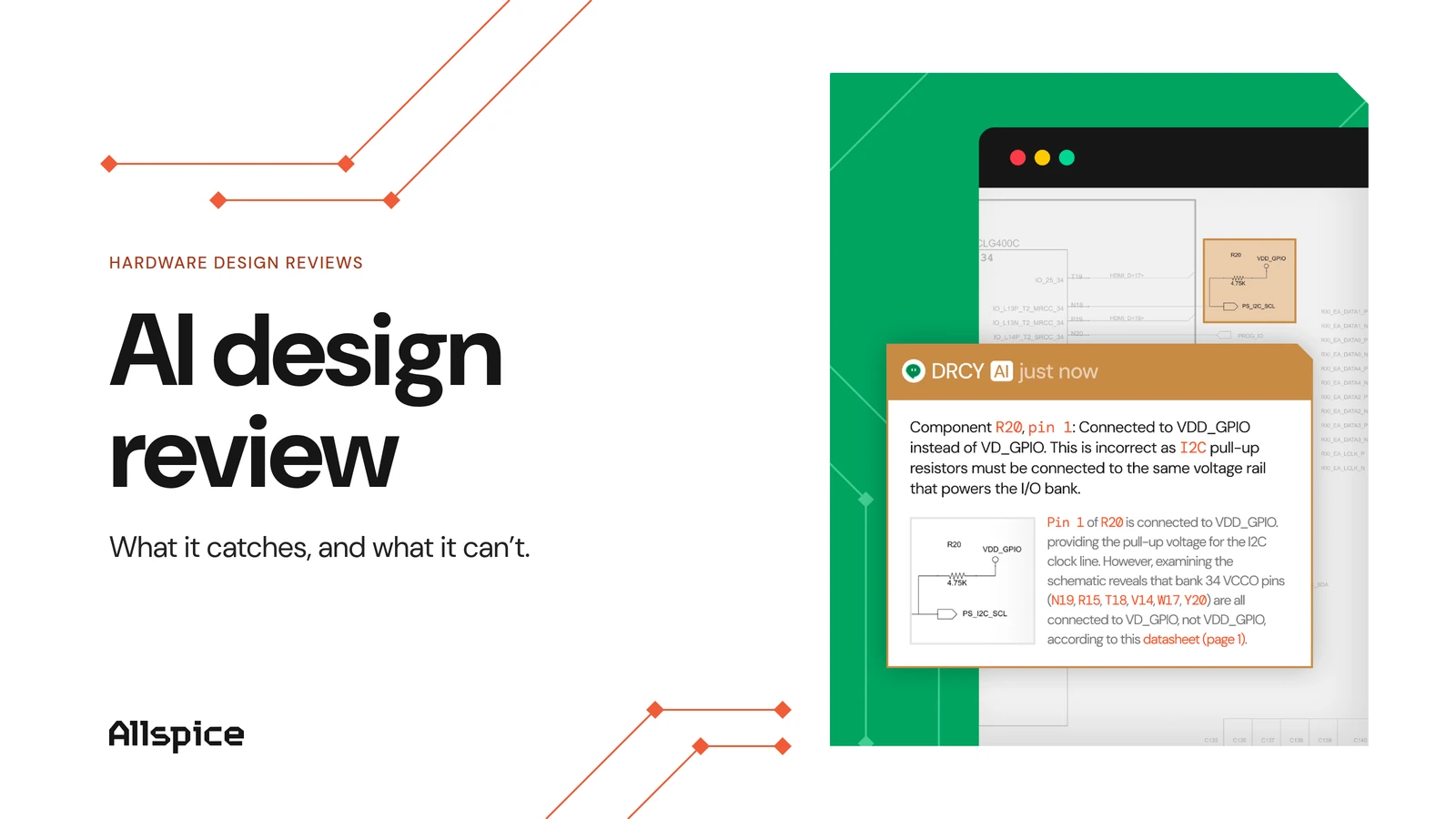
How Partner Electronics utilized DRCY to modernize design reviews
For Partner Electronics, staying on the cutting edge of electronics design consulting means continuously improving engineering tools and workflows. So when AllSpice rolled out DRCY for AI-assisted design reviews, they saw the perfect opportunity to modify their workflow to scale productivity. Over the past year, the team at Partner Electronics has integrated DRCY into real customer projects, using it as a first-pass reviewer alongside their own experienced engineers. Rather than replacing engineering judgment, DRCY became another reviewer in the process that could consistently check designs and highlight potential issues, giving engineers more confidence against downstream issues leading to schedule delays and cost overrun.
In this post, we'll look at how Partner Electronics incorporated AllSpice and DRCY into their existing review workflow, what they've learned from using it in production, and why they believe the future of hardware design reviews is a partnership between human engineers and AI.
Partner Electronics is a UK-based electronics and embedded firmware design services consultancy. Since 2007, the company has helped hardware organizations at all stages of product development, with expertise spanning electronics design, embedded firmware, RF, sensors, power electronics, compliance, and more. What’s their philosophy for success? Combine deep engineering expertise with a partnership approach that builds long-term relationships, while continuously improving products and the engineering processes behind them.
Challenges
Partner Electronics built their reputation on bringing high-quality design services to customers across a wide range of industries. With continued growth, however, the team faced challenges in scaling their engineering expertise and collaborative review processes.
Scaling engineering expertise across every project
Every new customer project brings its own industry requirements, technologies, and design constraints. The team of eight engineers at Partner Electronics needed to consistently deliver high-quality work across a diverse portfolio of designs while coordinating reviews between internal and external stakeholders.
As the number of projects increased, so did the demands on reviewers. Every design needed to be thoroughly evaluated before moving forward, and customers needed visibility into the review process as a useful way of collaborating across large designs.
The team needed a solution that could help them:
- Maintain consistent review quality across every project.
- Give engineers another layer of verification without replacing human expertise.
- Make design reviews easier to share and discuss with customers.
- Scale their review process without scaling engineering overhead at the same rate.
Finding issues before they became too expensive
Even experienced engineers can miss subtle design issues, especially as projects grow in size and complexity. Small issues can easily fall through the cracks if engineers are focused on system architecture and design intent. Are all pin numbers and names correct? Have the correct voltages been applied? Any EOL parts missed during initial review? Are all required pull-up resistors in place? These kinds of implementation details can easily plague large-scale designs, leading to downstream issues.
Additionally, minor schematic changes that appear insignificant during design reviews become more costly as hardware development progresses. An issue identified during schematic review might be resolved in a couple minutes. The same issue discovered during testing could require prototype rework, additional validation, schedule delays, and potential manufacturing changes. Partner Electronics couldn’t afford those kinds of late-stage issues.
A framework built for partnership
As a design consultancy, Partner Electronics had some unique considerations for their business which ultimately led them to AllSpice. Not only did they need to consider their own design workflows and review structures, but also how they interacted with their customers and what access levels were needed. The transparent, easy-to-collaborate framework of AllSpice was key.
- ECAD-agnostic support allowed a consistent engineering workflow regardless of which design tool their customers used: Altium, OrCAD, Xpedition, etc.
- Isolating projects through role-based access control enabled them to collaborate on multiple customer projects simultaneously while strictly managing any intellectual property or confidentiality concerns.
- A centralized engineering data platform combined design management, review comments, AI findings, and revision control into a single source of truth instead of the disconnected toolset they had been using previously.
- AI-assisted design reviews with DRCY provided a practical way to strengthen their existing review process and remain a leading consultancy with the most advanced technologies.
- The responsive team at AllSpice worked closely with them through regular feedback sessions. This collaboration led to rapid implementation of improvements and new features around AI workflows, issue management, reporting, and customer collaboration.
The value of AllSpice for enabling strong partnerships was clear:
"If you look at it purely on time saved, it’s easy to justify the cost of AllSpice. But honestly, the real win is that it helps us do a better job, faster—and our clients can see that."
— Richard Rydon, Managing Director at Partner Electronics
Creating a better design review process
Partner Electronics already had a structured design review workflow in place. AllSpice was introduced as a collaborative framework with DRCY as an additional first-pass review layer before formal peer review to catch issues humans might overlook.
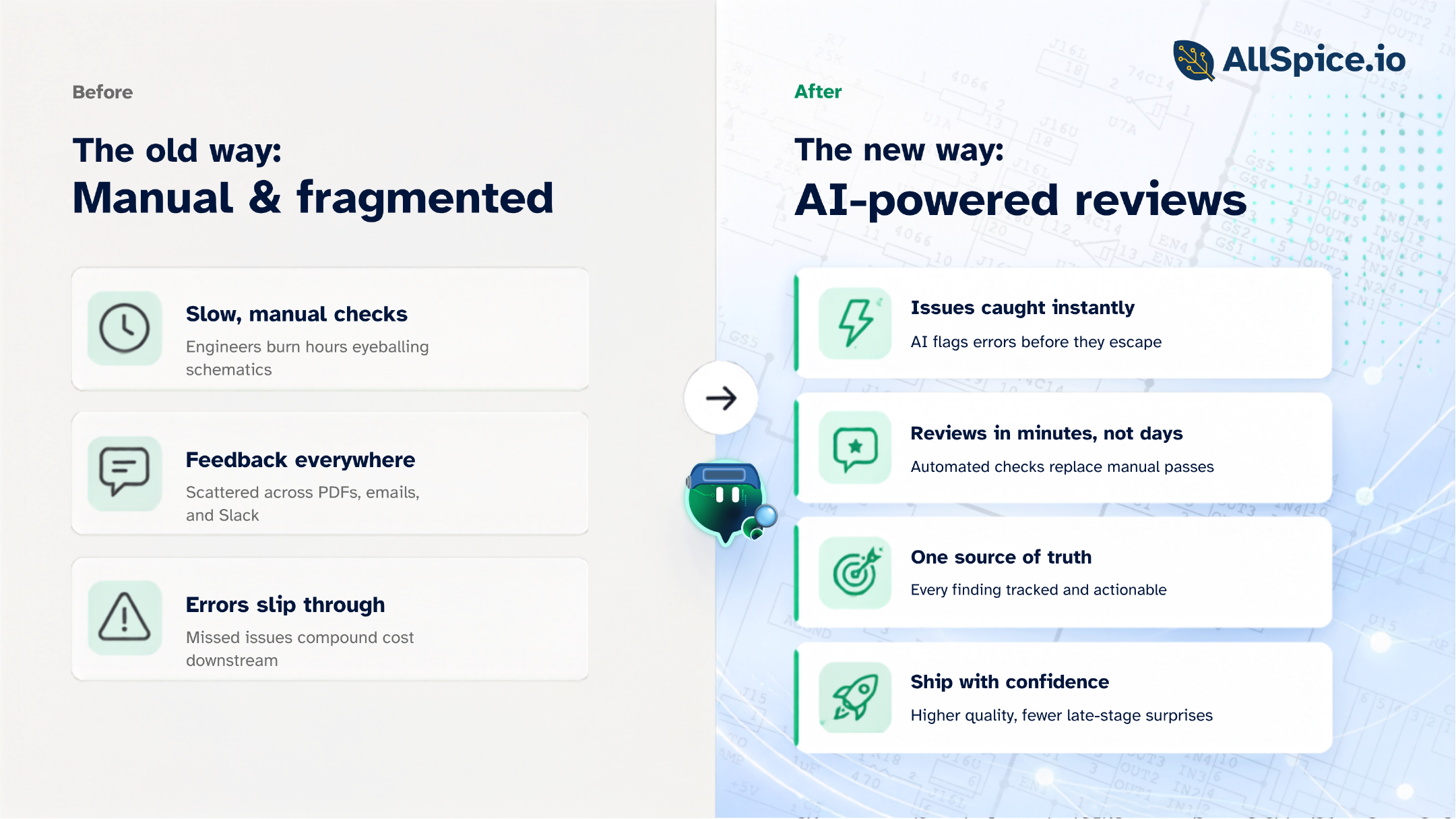
Before AllSpice
Their original review process followed a familiar engineering workflow:
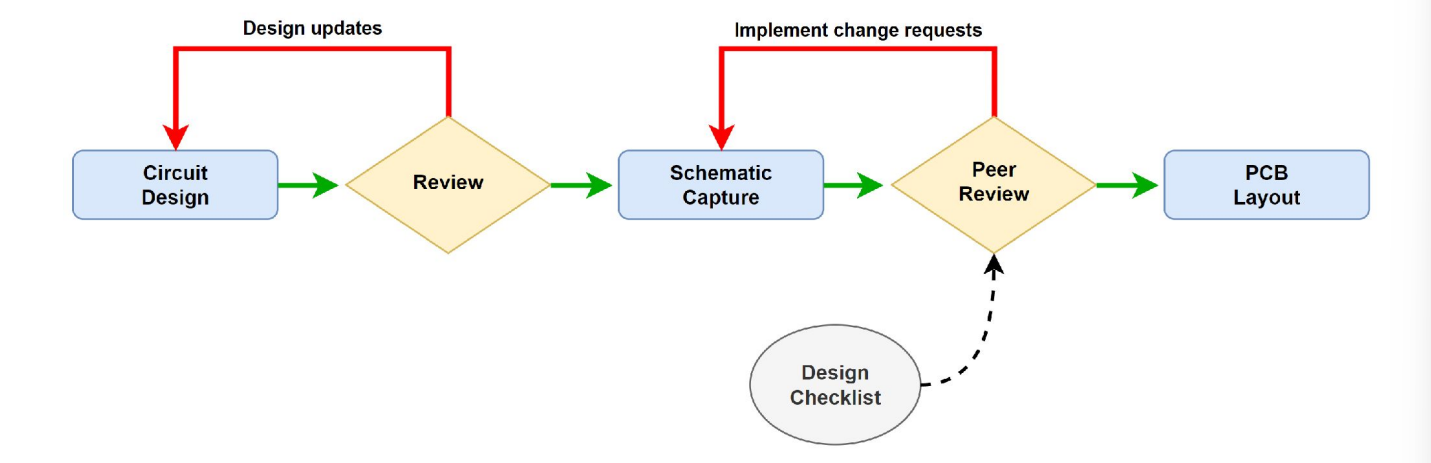
Any feedback from a review was incorporated back into the design, and the iterative cycle continued until the schematic was ready to move forward.
While this worked in principle, the limitations were evident:
"We’ve got a process, but it’s pretty manual things like marking up PDFs and passing them around between the team."
— Richard Rydon
After AllSpice
Once they adopted AllSpice, Partner Electronics added a DRCY AI review step immediately after schematic capture and before their formal peer review. In their new workflow, engineers collaborate with DRCY first to identify and resolve implementation issues, then enter peer review with an AI report to add alongside their standard design checklist.
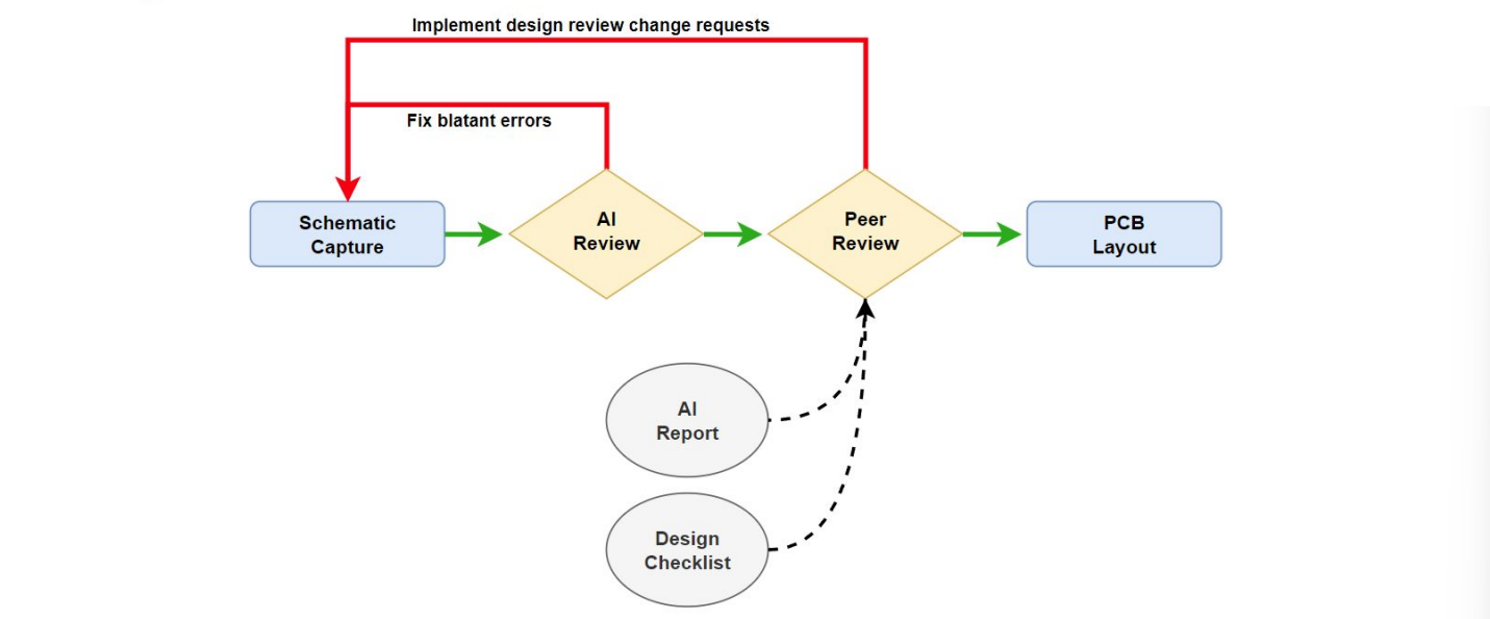
The updated workflow allows the team to catch obvious design issues earlier in the process and gives reviewers more time to focus on engineering decisions instead of routine checks. All the benefits of a normal peer review process are preserved while DRCY enhances the workflow with AI-generated insights.
The division of responsibilities allows each reviewer to focus on what they do best:
DRCY focuses on:
- Catching subtle design errors that are easy to overlook.
- Checking datasheet requirements and best practices.
- Identifying routine issues quickly and consistently.
Engineers focus on:
- Evaluating design intent and system architecture.
- Making engineering tradeoffs and design decisions.
- Confirming AI findings and approving the final design.
Owen Evans described the immediate impact:
"It’s helped us catch serious issues early before they became bigger problems which has been a real benefit to the business."
— Owen Evans, Engineer at Partner Electronics
5 real-world examples where DRCY caught important issues for Partner Electronics
Using this new workflow, DRCY was able to identify issues across multiple customer designs, ranging from incorrect component selection to subtle cross-sheet inconsistencies that could have resulted in board rework and schedule delay. A few of the more notable examples:
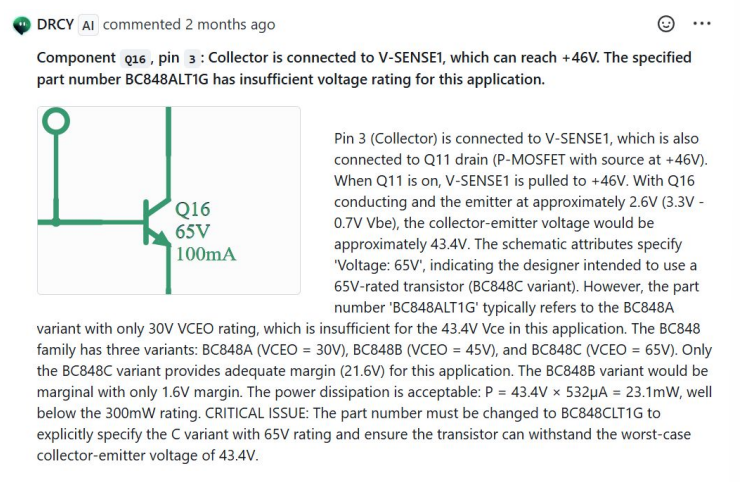
Example #1: Incorrect transistor variant
A transistor in the BOM used the wrong part number suffix, and a 30 V variant was inadvertently selected for a 43.5 V rail. Using an under-rated component like this could have resulted in device failure once the board was powered, but DRCY flagged the incorrect part number and recommended the appropriate 65 V variant instead.
Example #2: Pin assignments unintentionally changed
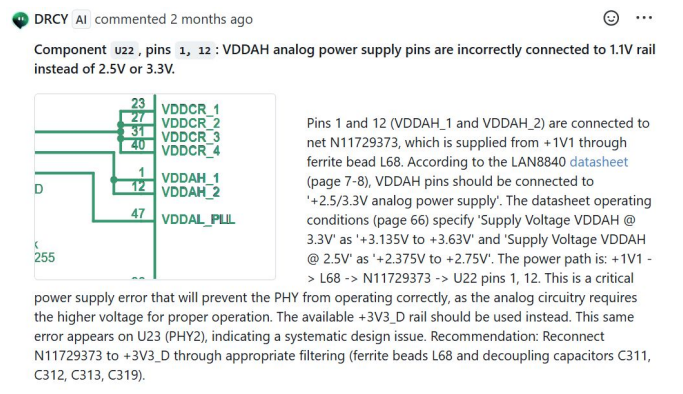
During a collaborative project, an engineer temporarily rearranged an IC's pins to improve schematic readability. However, a later library update quietly restored the original pin arrangement after the design had already been peer reviewed. Reviewers could have easily missed this kind of functional error as the design progressed, but DRCY detected it right away.
Example #3: Incorrect power connection
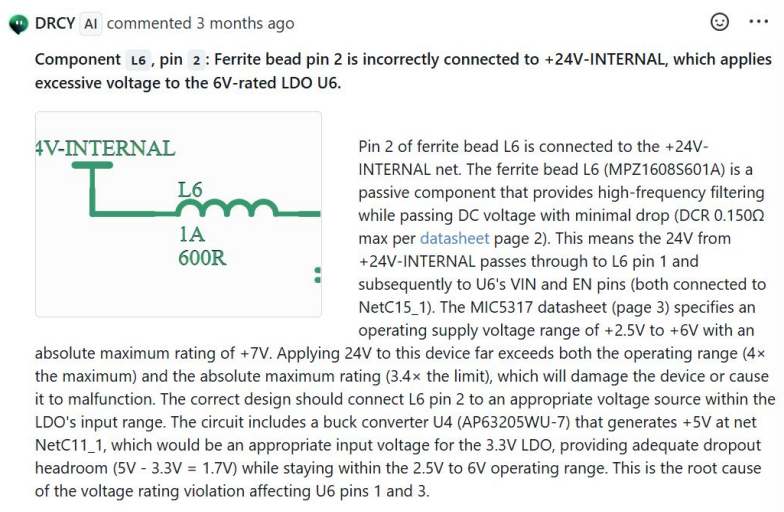
An LDO regulator was connected to the wrong power net, which would have resulted in regulator failure and board redesign due to incorrect input voltage. The team replaced the component with a compatible pin-for-pin alternative after DRCY flagged the incorrect power connection.
Example #4: Missing datasheet requirement
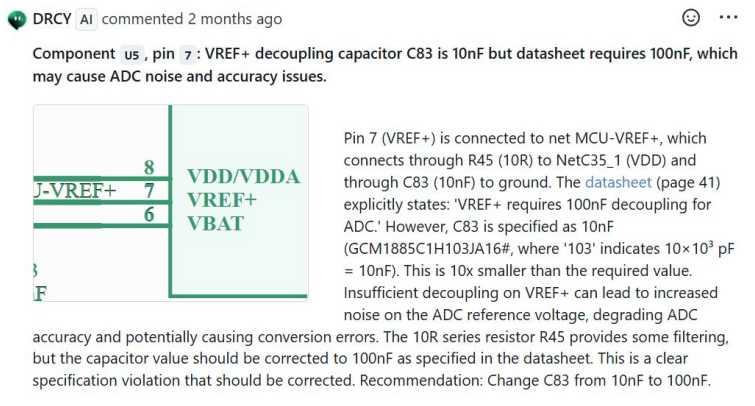
A device required specific decoupling capacitors, but this information was buried deep (on page 41!) in the datasheet and not implemented correctly in the design. This is a common scenario DRCY excels at: uncovering important implementation details buried dozens of pages into component documentation.
Example #5: Voltage mismatch across schematic pages
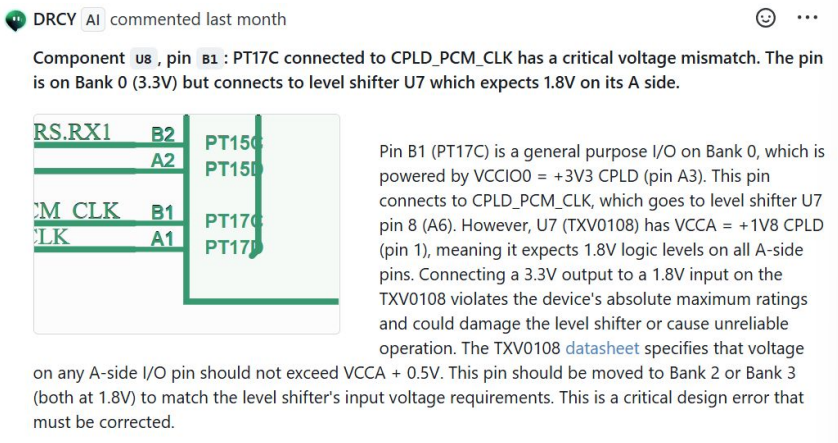
One signal originated from a different CPLD pin bank and operated at a different voltage than the related signals. This mismatch required different level shifting, but because the signals were spread across multiple schematic pages, the issue was difficult to spot during manual review. Since DRCY analyzes designs holistically, it was able to recognize the voltage mismatch and identify the missing level shifting requirement.
More than just finding errors
As evidenced by these examples, the value of DRCY isn’t just the total number of issues it finds. It’s the role it plays in the engineering process and how it collaborates with human reviewers. DRCY adds another perspective and surfaces issues that need a second look.
One engineer described their experience:
"It's a very useful option to have to be able to put designs through and get almost a third-party external sanity check."
— Andrew Templey, Senior Electronics Engineer at Partner Electronics
Since Partner Electronics operates as a consultancy, the impact extended beyond internal engineering reviews. Frequent collaboration with customers throughout the design process became much more productive by focusing on engineering decisions instead of preventable mistakes. Having DRCY identify issues before designs were shared helped keep those conversations on track.
Building better together
Adopting AllSpice and DRCY wasn’t the end of the journey. Through regular conversations with our product team, Partner Electronics became active in shaping how AI-assisted design reviews should evolve. They provided feedback on everything from issue management and customer collaboration to reporting structures and AI interface implementation. This kind of relationship reflects how AllSpice builds products: working closely with customers to solve real engineering challenges and quickly provide improved workflow solutions.
The collaboration is already influencing AllSpice’s product roadmap. Planned capabilities such as chatting directly with DRCY, repository-wide engineering knowledge, reusable engineering feedback, simplified stakeholder reports, and more targeted AI interactions are all being developed to boost efficiency while keeping humans firmly in control of engineering decisions.
The goal is to make AI a more knowledgeable and responsive partner to work alongside experienced engineers and reviewers. As hardware systems continue to grow in complexity, design reviews will increasingly combine the strengths of both humans and AI. AI can provide consistency and detail across large designs. Engineers contribute the context, judgment, and experience needed to make the final decisions. Together, they create a review process that’s more thorough, more scalable, and ultimately more reliable than either could achieve alone.