How hardware organizations roll out AllSpice
A practical rollout plan for engineering leaders, from first design review to org-wide standard.
Most hardware organizations assume AllSpice rollout is a single moment. A kickoff. A migration. A “go live.” In practice, the teams that get real value from AllSpice don’t treat it like a launch. They treat it like a progression.
The best teams see meaningful value in the first two weeks. From there, they expand deliberately, turning design reviews into a repeatable system instead of a bottleneck.
This guide lays out what that progression looks like, what “good” looks like at each stage, and how to get there quickly.
What this unlocks for your business
Before getting into the rollout details, it’s worth briefly covering why this matters. When AllSpice is rolled out effectively, teams see:
- Fewer late-stage surprises. Issues surface early, when fixes take hours instead of weeks and cost hundreds instead of hundreds of thousands.
- Faster time to production. Reviews happen continuously, not in compressed, high-risk cycles.
- Scalable engineering output. Quality and review coverage increase without adding headcount.
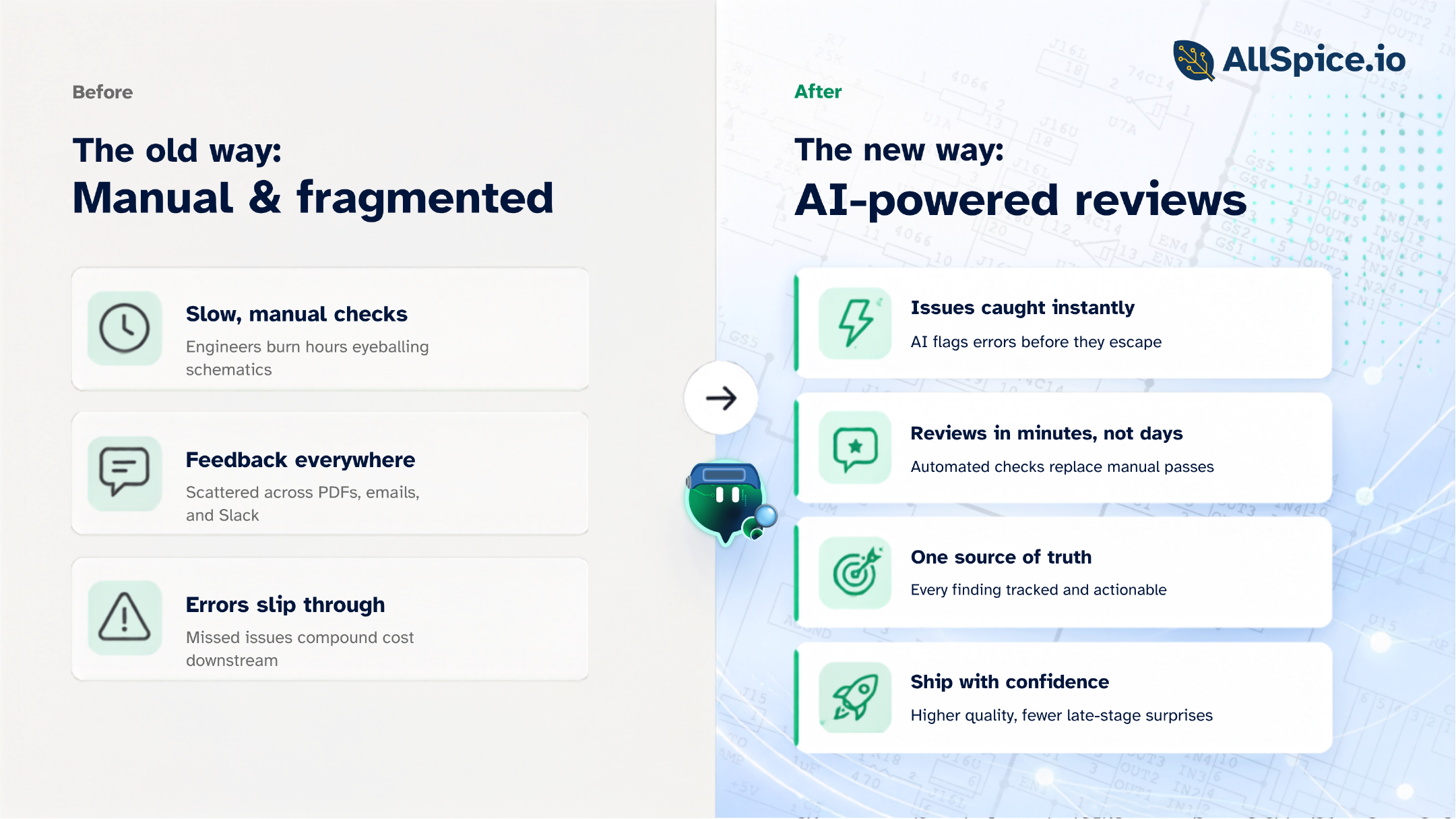
- Consistent, auditable design reviews. Every design gets a first-pass check with traceable findings, not variable coverage based on who reviewed it.
- Stronger cross-functional collaboration. Electrical, mechanical, firmware, sourcing, and manufacturing all work from the same design context without needing ECAD seats.
This is the shift from design reviews as a bottleneck to design reviews being a continuous, integrated practice.
A maturity model for hardware
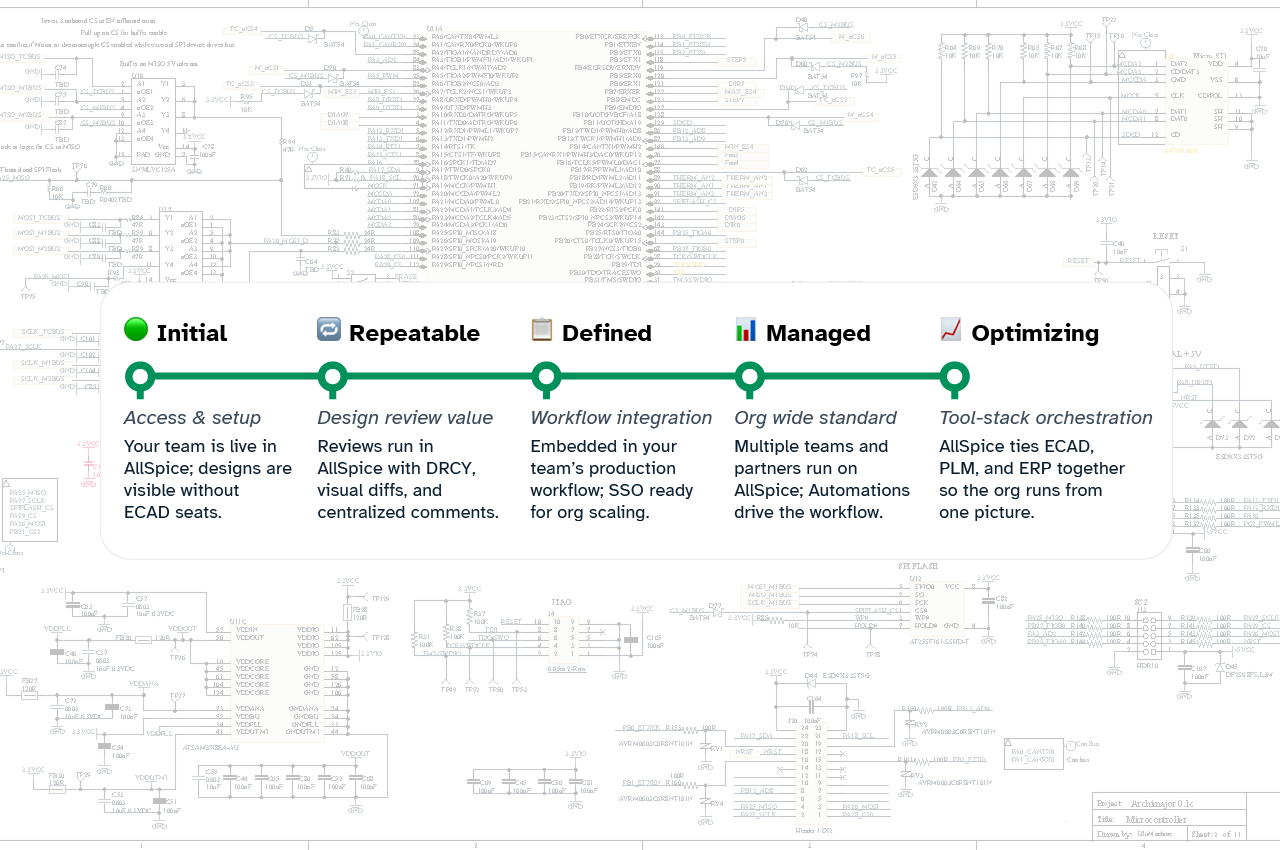
Rolling out AllSpice is a five-level progression. Each level builds on the last, and each answers the question every team is really asking: what does "good" look like at this stage, and what should we focus on next? The progression runs from getting setup on AllSpice (Level 1), to running real design reviews (Level 2), to integrating into your team's production workflow (Level 3), to scaling across the org (Level 4), to orchestrating across your full tool stack (Level 5).
We've borrowed from the Capability Maturity Model. It has been used for forty years to describe how organizations move from initial to optimized in any complex capability. AllSpice is a complex framework inside your hardware tooling ecosystem, helping your team build complex products. The five levels apply cleanly to hardware design collaboration.
Each level brings its own challenges. Iterations cost real money; a missed issue is a respin, not a hotfix. External partners (ODMs, suppliers) sit inside the workflow rather than alongside it. Tool fragmentation is the norm, with multiple ECAD tools alongside PLM and ERP. Reviews are inherently cross-functional with EE, mechanical, firmware, sourcing, and manufacturing all having stakes. The five levels show up differently because of those forces.
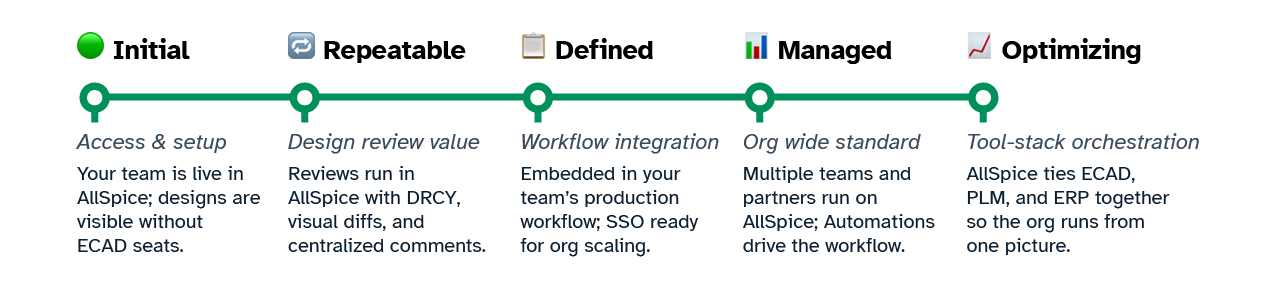
Level 1 - Initial: Get on AllSpice
The goal: AllSpice is set up for your initial team, and engineers can see designs without ECAD seats.
The bar isn't sophistication; it's accessibility. Every colleague who needs to see a design can see it without burning an ECAD license.
Capabilities you'll use:
- Organization setup and team permissions. Your team is configured with the right access from day one.
- User invites. Engineers, reviewers, and stakeholders are active in AllSpice.
- ECAD-agnostic file uploads. Projects from Cadence, Altium, Mentor, or KiCad come in without conversion.
- In-browser viewing of schematics and PCBs. Anyone who needs to see a design can, without an ECAD seat.
Why this matters: access is the gating constraint on every other stage. It's also where you set the permission model that protects your IP and keeps access clean as you grow. As long as designs live behind ECAD licenses, cross-functional review is gated by tool seats, not by who needs to see the work.
What "good" looks like: every relevant colleague is invited and active, and your first projects are loaded. Most teams reach Level 1 within a few days of kickoff.
Level 2 - Repeatable: Design review value
The goal: Your team runs design reviews in AllSpice, catching issues early.
This is where AllSpice value becomes tangible and usage repeatable. Reviews become a consistent practice the team runs the same way each time, as often as the work demands.
Capabilities you'll use:
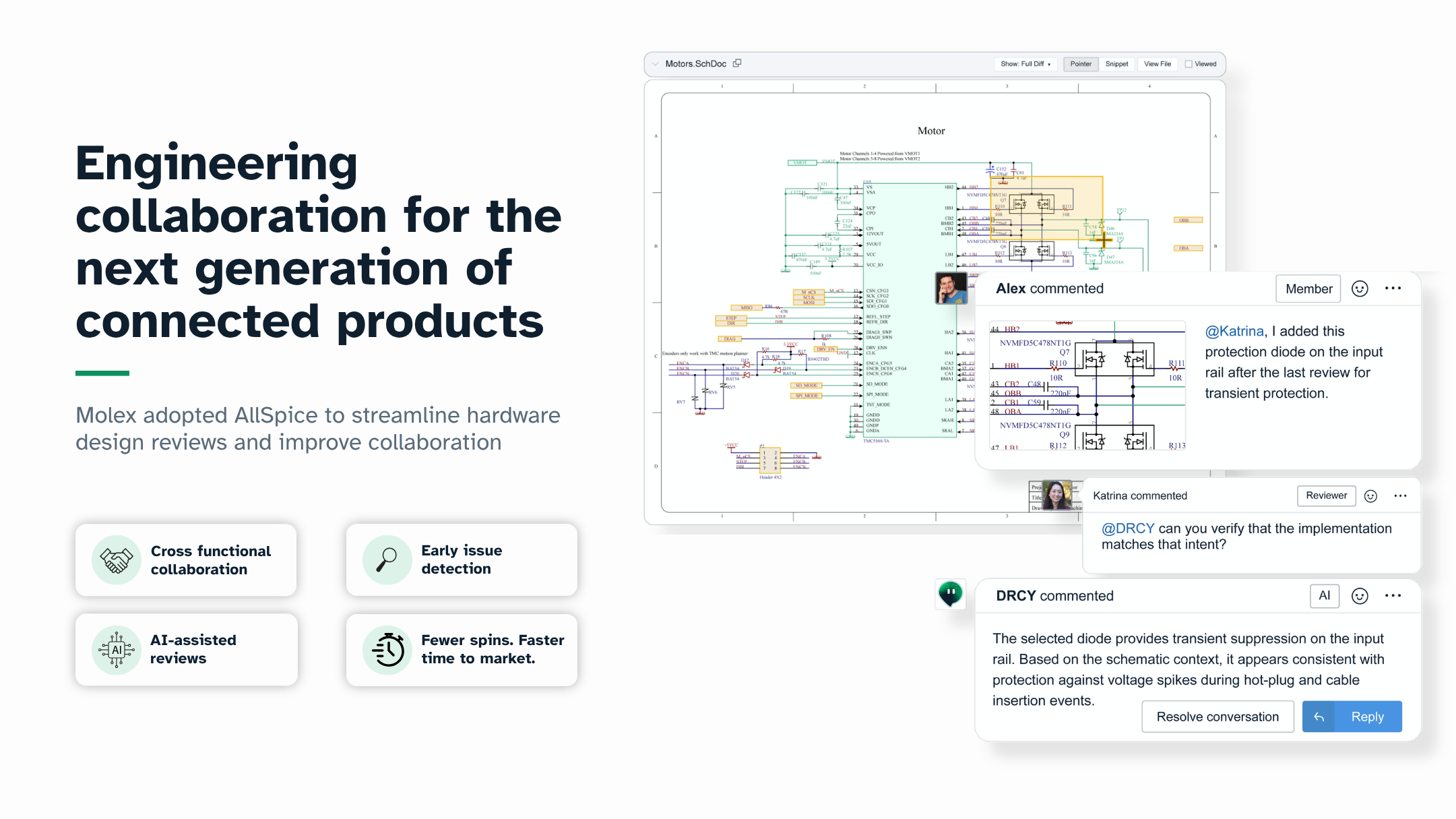
- AI-assisted schematic reviews via DRCY. First-pass review flags component and connectivity issues, so reviewers focus on system-level decisions.
- Visual diffs across schematics and PCB layouts. Changes between revisions are obvious at a glance, no more comparing designs between two monitors.
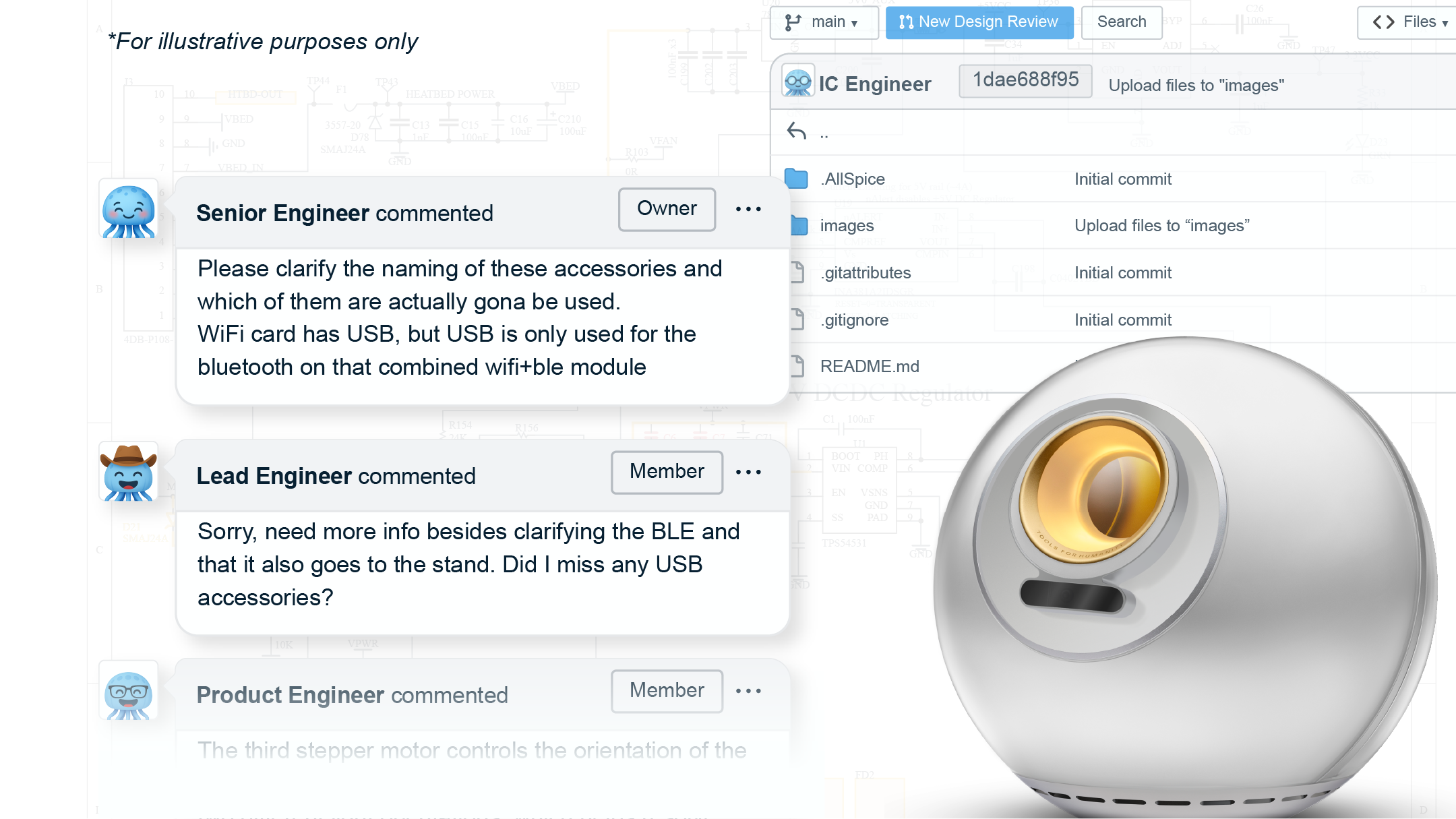
- Centralized collaboration. Comments live in the design review, not in PDFs and email threads. Every decision and discussion stays attached to the design.
Why this matters: issues caught at the schematic cost hours; issues caught at manufacturing cost respins. Electrical, mechanical, firmware, sourcing, and manufacturing all engage with the design without each needing an ECAD seat. More eyes early means fewer surprises late.
What "good" looks like: your team is running real design reviews in AllSpice, with issues identified and resolved inside AllSpice rather than across email threads and PDFs. Most teams reach Level 2 within the first two weeks.
Level 3 - Defined: Workflow integration
The goal: AllSpice is embedded in your team's production workflows, bringing the structured collaboration and traceability that complex hardware design has always demanded.
This is where AllSpice fits into how your initial team actually designs. Engineers move past upload-and-review, and internal champions start experimenting with advanced capabilities like Automations.
Capabilities you'll use:
- Structured change review. Engineers propose design changes against the current revision, reviewers see exactly what's different, and approved changes are incorporated.
- Scalable access via SSO. Org-wide access supports adoption beyond the initial team, starting to spread.
- Engineers graduate to syncing directly with the source files. Files flow in both directions between AllSpice and the engineer's local design environment, replacing browser uploads.
- Project management. Issues and Milestones track design work and roll them up to Releases.
- Design checklists captured as templates. Your review criteria, often the institutional knowledge that makes your products yours, become reusable templates that appear in every design review and give everyone a shared view of progress.
Why this matters: most hardware teams run production design across shared drives, ECAD tools, email, and spreadsheets. There's no single place where the workflow lives. Level 3 brings those pieces into one system that fits how your team already works. Engineers spend less time stitching tools together and more time designing.
What "good" looks like: Your team's production designs live in AllSpice. Files, revisions, reviews, and the checklists that capture your engineering know-how all live in one place, and progress is visible without anyone asking.
Level 4 - Managed: AllSpice becomes the org-wide standard
The goal: Automations begin to carry the routine work; your toolchain and partners feed into one workflow.
Adoption reaches beyond your initial teams, into other divisions and to your external partners. Your toolchain starts populating AllSpice automatically, and a Tools administrator emerges to keep the system running cleanly.
Capabilities you'll use:
- Organization-level structure with team-scoped projects. Clean separation across teams and divisions.
- Workflow Automations. When new designs are ready, AllSpice generates BOMs and PDFs automatically, reducing manual work.
- Centralized administration. An Tools owner manages permissions, automations, and integrations.
- External partner access. ODMs and suppliers work inside AllSpice rather than through email and spreadsheets.
- PLM integrations. Component datasheets flow into AllSpice from your existing toolchain, so tools like DRCY always work against current information.
Why this matters: hardware procedure is unavoidable, with design reviews, ECN approvals, sign-offs, supplier handoffs, and quality gates around every release. Either your engineers carry that load, or software can. When Automations carry it, your engineers spend their time on design judgment, and reviews get more consistent because rules are enforced rather than remembered.
What "good" looks like: your toolchain syncs with AllSpice, reflecting the latest changes automatically. The majority of design teams and divisions are standardized on AllSpice. Partners are part of your workflow, not parallel to it. The Tools owner is constantly monitoring and improving the system.
Level 5 - Optimizing: AllSpice drives the tool stack
The goal: AllSpice orchestrates design data across your stack; ECAD, PLM, and ERP stay in sync.
AllSpice becomes the connective layer across your hardware stack, not a replacement for it. Design data moves automatically between ECAD, PLM, ERP, and AI tools, so engineering, manufacturing, and operations all work from the same current picture.
Capabilities you'll use:
- Two-way integrations with PLM, Jira, and similar systems. A merged design change updates the PLM. A critical design issue triggers a Jira ticket and a Teams notification.
- Custom Automations that trigger downstream actions. Updates flow out to connected systems automatically.
- Direct API access for any internal tool. Read or write design data from anywhere in your stack.
- AllSpice as a native data source for AI agents (via MCP). AI tools reason against current design data, not stale exports.
Why this matters: with design data in one place, you unlock things that aren't possible when it's fragmented. AI agents can reason against current data. You can answer audits with a query, not a fire drill.
What "good" looks like: AllSpice isn't a tool the engineering team uses. It's how the company runs hardware.
How to measure success
A few signals will tell you whether AllSpice is taking hold:
Adoption. Are real production design reviews happening in AllSpice, not just test runs? If they aren't, nothing else matters.
Issues caught early. What share of issues are surfaced at the schematic stage instead of layout or manufacturing? This is the metric that ties AllSpice to dollars saved.
Cross-functional participation. Are mechanical, firmware, sourcing, and manufacturing engineers showing up in reviews, or are reviews still only electrical? The breadth of who reviews tells you whether the cross-functional unlock has landed.
These are your Level 3 indicators. Beyond Level 3, you'd add metrics like external partner participation and toolchain integration coverage, but get these three right first.
What we've seen work
Across teams that move quickly:
They get to design review value fast. One team, real designs, within the first two weeks.
They identify internal champions early. Engineers who adopt quickly and pull others in.
They invest in ownership before scaling. IT and Tools ownership become critical at scale.
They bring partners into the system early. Avoiding parallel workflows reduces long-term friction.
They don't skip steps. Each stage builds the foundation for the next.
The takeaway
Most hardware teams today sit somewhere between ad hoc workflows and partial standardization. The teams that pull ahead are the ones that make design reviews systematic early.
AllSpice is not a tool you "turn on." It is infrastructure you build into your workflow. The teams that do it well don't wait for a perfect rollout. They start with one team, one project, and one design review, then build from there.
Most teams we work with reach meaningful value in the first two weeks. If you're evaluating AllSpice, we can map your current workflow to this model and outline your first rollout phase.