Better hardware for hardware engineers
AllSpice CEO and co-founder Valentina Ratner spoke with Electronic Specifier’s Paige West on their Electronic Specifier Insights podcast. They discussed the founding story and mission of AllSpice, how the platform is streamlining workflows for electrical engineers and hardware engineers, and what the future holds.

Conversation highlights
What was the spark that led to creating the hardware engineering platform?
Co-founders Valentina Ratner and Kyle Dumont were mechanical and electrical engineers by training, so they’ve experienced frustrations like trying to bring a product to market but having issues with the infrastructure. So, when given the opportunity to be involved in and see the effectiveness of internal productivity and collaboration software, Valentina, alongside Kyle, was inspired to help engineers build hardware products more efficiently. Based on this they created AllSpice, and the rest is history.
How does AllSpice work for electrical engineers and hardware engineers?
AllSpice.io is the hardware development platform that empowers engineers to modernize their workflows using Git. Coming up as engineers, the co-founders noticed hardware teams trying to adapt software developer tools for designing electronics. They decided to create the same robust tools software teams had but optimize them for hardware teams. Ultimately, the platform provides a DevOps ecosystem for hardware engineers. Sort of like Github, but instead of for code, it is for PCBs, schematics, bill of materials (BOMs), and all the building blocks of hardware products.
What are some trends and challenges engineers are facing in the hardware industry?
Some of the biggest trends/challenges are:
- Product timelines are getting shorter
- Increasing design iterations and revision frequencies
- Chip shortages that impact electronics manufacturing
Engineers facing these shifts prioritize efficiency, speed, and agility in their day to days. AllSpice has worked to provide just that for electrical and hardware engineering teams.
Your platform works to automate workflows with the goal of boosting efficiency. How was your experience building that?
AllSpice.io is a tool that many desired to have but that the industry, unfortunately, lacked. In the past, engineers worked independently in their specific fields – there were silos, resulting in little to no cross-team collaboration. Breaking down those silos and building transparency, communication, and collaboration brought immediate change to hardware engineer’s workflows’ for the better. Also, since hardware products in general are incredibly interconnected and interdisciplinary – is it vital that everyone is on the same page. Thankfully, AllSpice.io automates the process of design reviews/feedback, leading to a much smoother project workflow.
How does AllSpice.io close the communication gap when it comes to design reviews/revision control?
Communication is essential for any project. Studies show that 57% of all projects fail due to the lack of effective communication. And oftentimes, minor issues that are easily avoidable tend to be the root of the problem. Engineers value the simplicity of AllSpice.io because project communication is made effortless.
Rather than using a PDF export for revision control and design reviews, hardware engineers can easily invite and manage committers, contributors, and collaborators on the platform, allowing easy sharing of projects. Ultimately, AllSpice.io is built by engineers for engineers to create an environment for efficient engineering.
How does the use of engineering tools differ based on industry?
Many industries use AllSpice.io, such as:
- Aerospace
- Consumer electronics
- Automotive
- Autonomous vehicles
- Transportation
- Instrumentation
Different industries and teams use the platforms’ tools in a variety of ways depending on their needs. Some focus on customization, while others are more so set on volume and speed. Naturally, although there are many consistencies within the workflows of industries, there are also some nuances – there is no set-in-stone process to build hardware.
How does Allspice help engineers navigate their way through a growing digital space?
The traditional process, for example, in running a design review, is getting everyone within the same room, getting feedback/comments, following up, and so on. The issue with that is finding a day and time that works with everyone’s (typically busy) schedule, organizing and hearing everybody’s notes/feedback, and the duration of following up and closing the loop on the review.
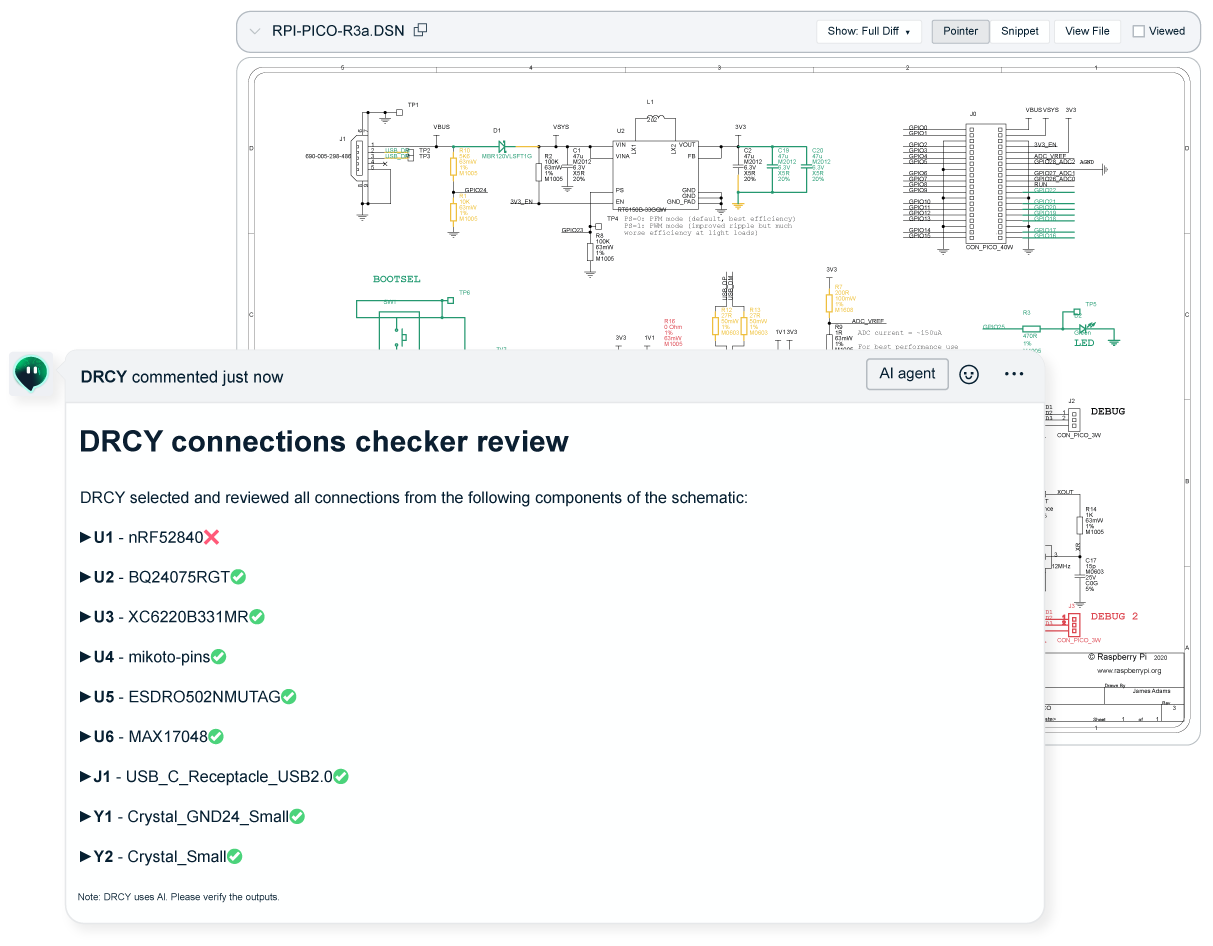
In AllSpice’s digital, asynchronous approach, design reviews are run similarly to the software industry pull requests. In just one click, review packages are automatically created, including redlines of the changes and detailed breakdowns all the way to the metadata level. Reviewers can be added and see the information when their schedule permits. To ensure efforts are not duplicated and actions are clear there is a record of history and traceability into all the design decisions, helping with troubleshooting and documentation. Essentially, this brings hardware collaboration to modern workflows.
How will your additional venture capital funding impact the workflow of electrical and hardware engineers?
There are two main improvements that AllSpice will be focusing on:
- Increasing enterprise support
The hardware development platform has been experiencing a growing number of enterprise companies and naturally wants to increase native support so users can have a seamless experience. This includes supporting additional ECAD formats.
2. Automation
AllSpice views automation as a world of DevOps, such as continuous integration (CI) and continuous deployment (CD), which is planned to be released this year.
What is AllSpice’s five year plan to continue to improve the workflow of platform users?
AllSpice will continue to empower hardware teams through automated tasks like the continuous integration (CI) engine, running simulations, emulations, and things on the cloud – these open the door to artificial intelligence (AI) for electronics and other next-gen implementations.