Hardware DevOps: how CI/CD impacts Electrical Engineers
I recently discussed CI/CDs impact on hardware development with my co-founder Kyle Dumont, and Electrical Engineer/Hardware DevOps Lead Daniel Lindmark. We chatted about the challenges in hardware development leading to the creation of AllSpice, collaboration and automation, and continuous integration (CI)/continuous deployment (CD) in hardware DevOps.
Where are many engineers today?
Hardware engineers have faced many obstacles in past processes like having to depend on PDFs, Excel, and other spreadsheets, poor communication and ways of collaboration on hardware designs, and an overall prolonged hardware development process.
In listening to the challenges of fellow engineers through surveys, zoom calls, and conferences, we set out to create AllSpice.io, a collaboration and automation platform designed for Hardware Engineers, Electrical Engineers, and PCB Designers. It uses Git to empower engineers in modernizing their workflows with centralized issues and design reviews, a powerful API, CI, and more – in any ECAD format.
In a nutshell, there are three pillars within AllSpice:
- Git powered revision control to document, track, and manage designs
- Design review and workflows resulting in more visibility, accuracy, and collaboration
- Automation and continuous integration automatically validating, verifying, and checking for parts, information, releases, and errors
Naturally, we understood that the next iteration of modernizing hardware design was to empower engineers with CI/CD for hardware, something we call Hardware DevOps.
What is hardware DevOps?
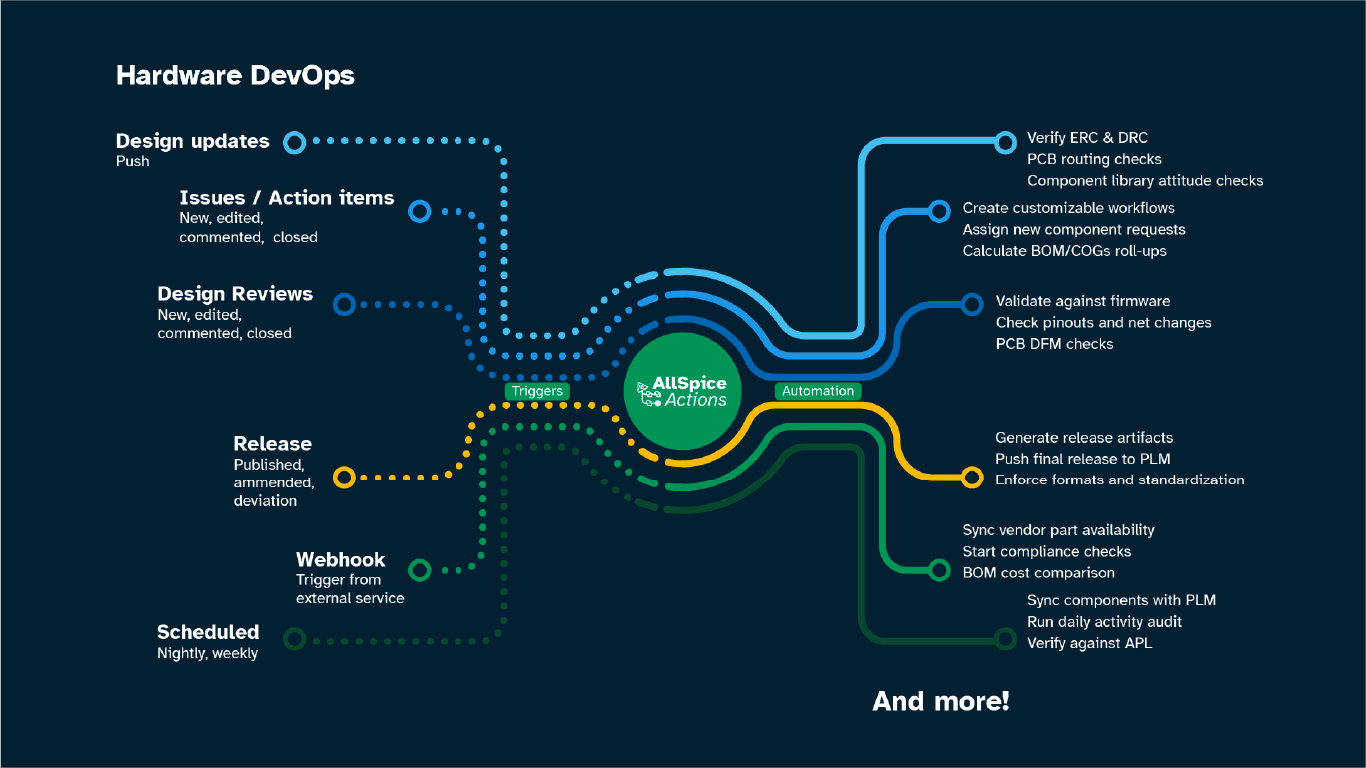
Essentially, hardware DevOps combines the necessary practices and tools that enable engineers to streamline and automate their design processes, such as continuous integration. AllSpice implements CI through AllSpice Automations, a feature within the platform that automates tasks, validations, and checks that would otherwise be manually performed.
How to use CI/ CD for hardware design
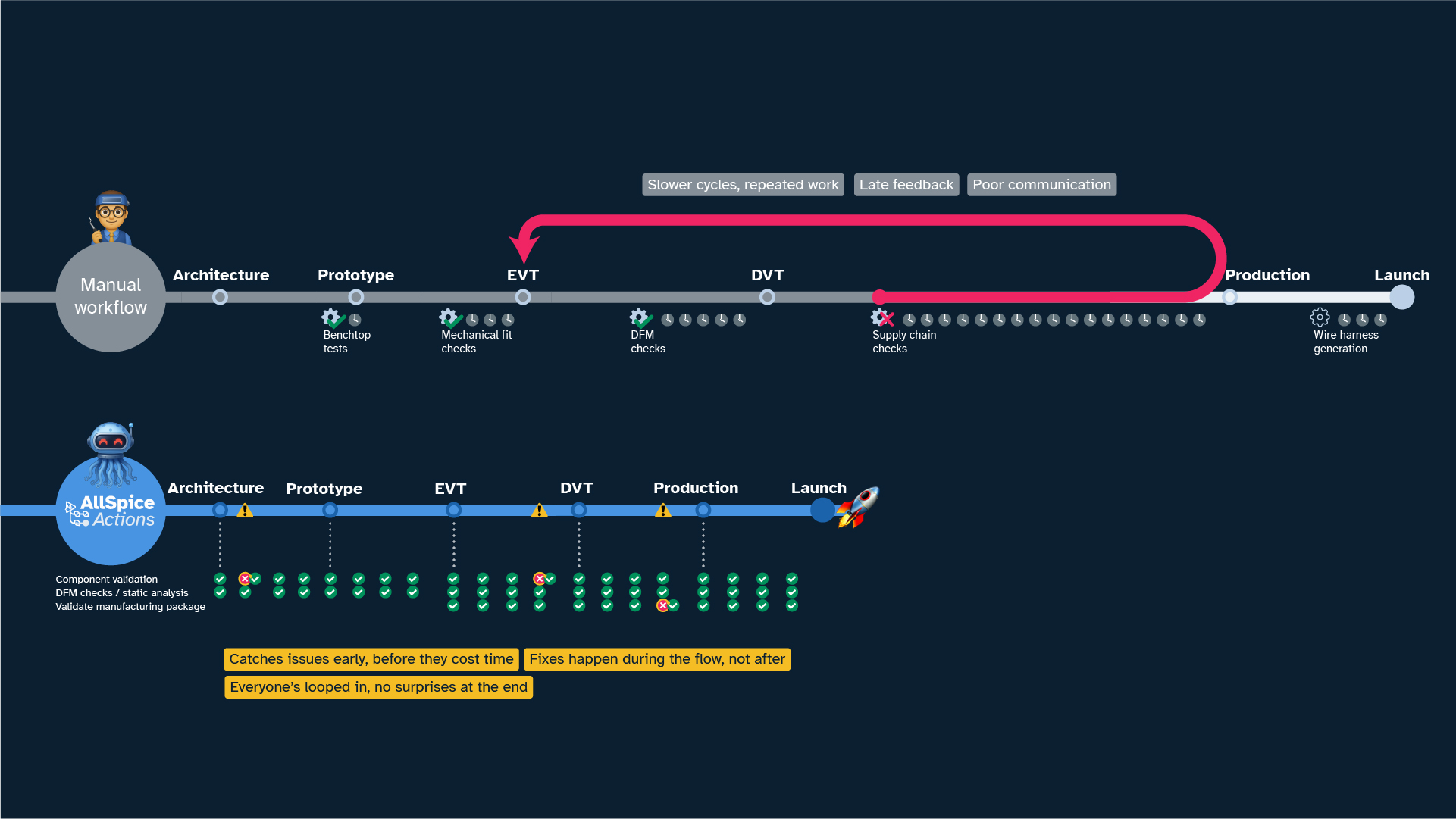
When looking at traditional hardware workflow processes, you will see that the stages (architecture, detailed design, EVT, DVT, production and launch) take significantly longer, due to them being performed manually, rather than using CI.
What kind of tests can be run with Automations electronics design?
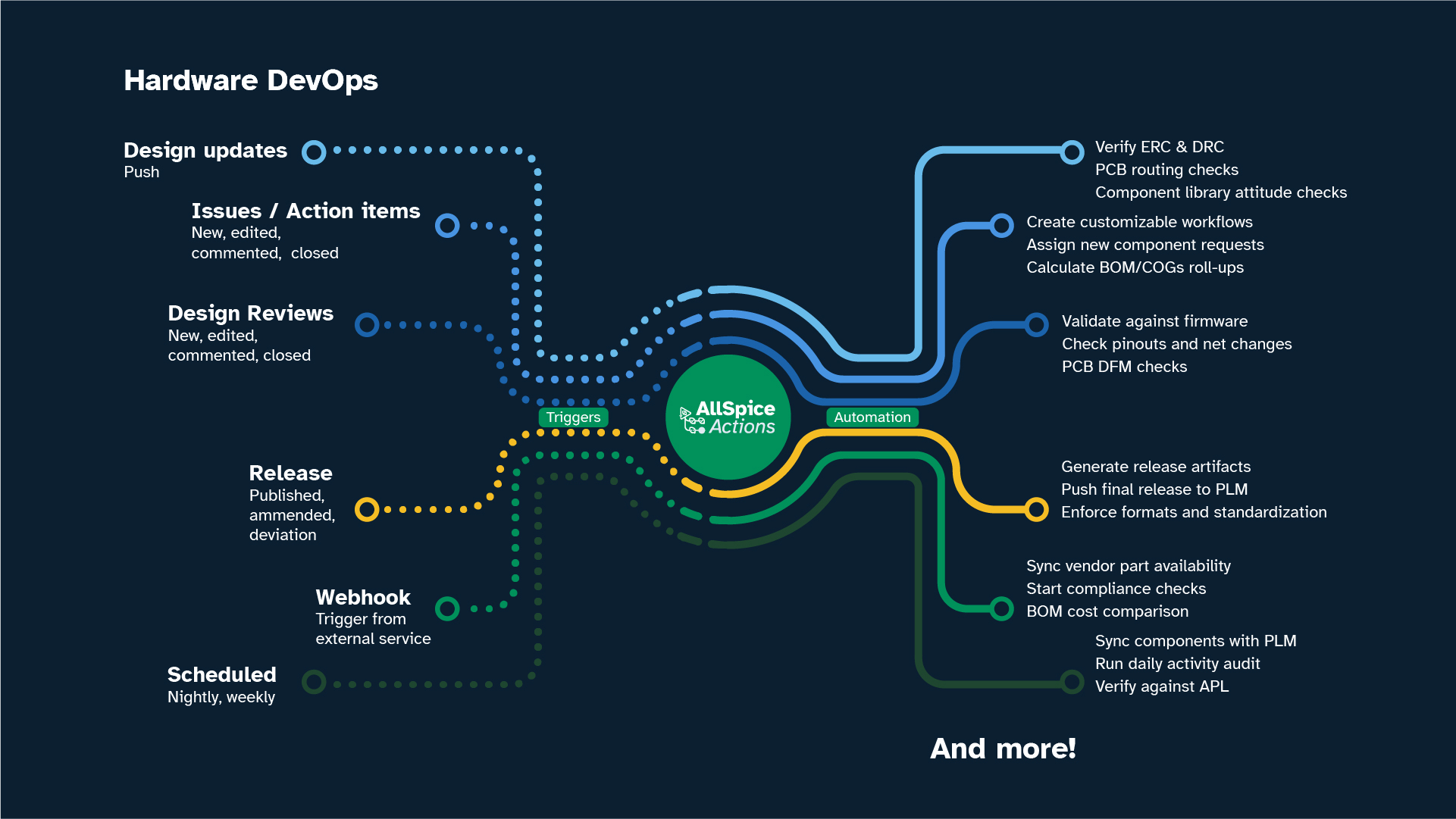
Due to the flexible nature of AllSpice Automations, there are many tests that can be run, and the AllSpice library contains a list of tests that can be added. Some include:
- Generating BOMs
- COGS
- Components
- Set up triggers
- Third party API
What are the core components of CI/CD during the hardware development process?
- Runners: run workflows and perform intended jobs/steps
- Workflows: YAML files that contain the automated steps, tests, and verifications
- Triggers: events that initiate a workflow file
- Jobs: a series of related or grouped together steps
- Steps: details of the specific task, test, or verification that you want to happen
- Scripts: programs that perform the CI/CD automation
- Add-ons: modular, turn-key actions with a configurable interface
What alternative use cases does AllSpice Actions support?
- Automatically calculate carbon emissions derived from a BOM
- Perform automatic failure mode and effects analysis (FMEA)
- Generate test fixtures from test points
- Create connector diagrams to aid in verifying PCB interconnects
- Generate a firmware interface document that lists software controlled nets
Implementing continuous integration (CI) and continuous deployment (CD) while developing hardware will allow your team to make design changes at any time without affecting your timelines. And, AllSpice Automations uses the power of CI and Git to modernize your workflows.