Power and grounding issues hiding in plain sight
Power problems are a classic source of late surprises in hardware development. A schematic can look organized and still contain subtle issues across rails, grounds, regulators, and supporting circuitry. The challenge is that power architecture is distributed. It spans pages, symbols, annotations, and assumptions that may not sit next to each other visually.
Common examples
- A rail is connected where it should not be.
- A required supporting connection is missing.
- Ground references do not resolve as expected across the design.
- Regulator configuration does not match the intended operating conditions.
Why teams miss these problems
Power circuitry often combines repetition with complexity. Reviewers recognize familiar patterns and understandably move faster through them. But that same familiarity makes it easier for small deviations to disappear into the background. Multi-page schematics add another layer of difficulty. A reviewer may correctly understand one local section while missing how it interacts with the rest of the design.
A TVS diode with reversed polarity
One useful example is a protection diode that appears to be in the right place, but is connected in a way that prevents it from doing its job.
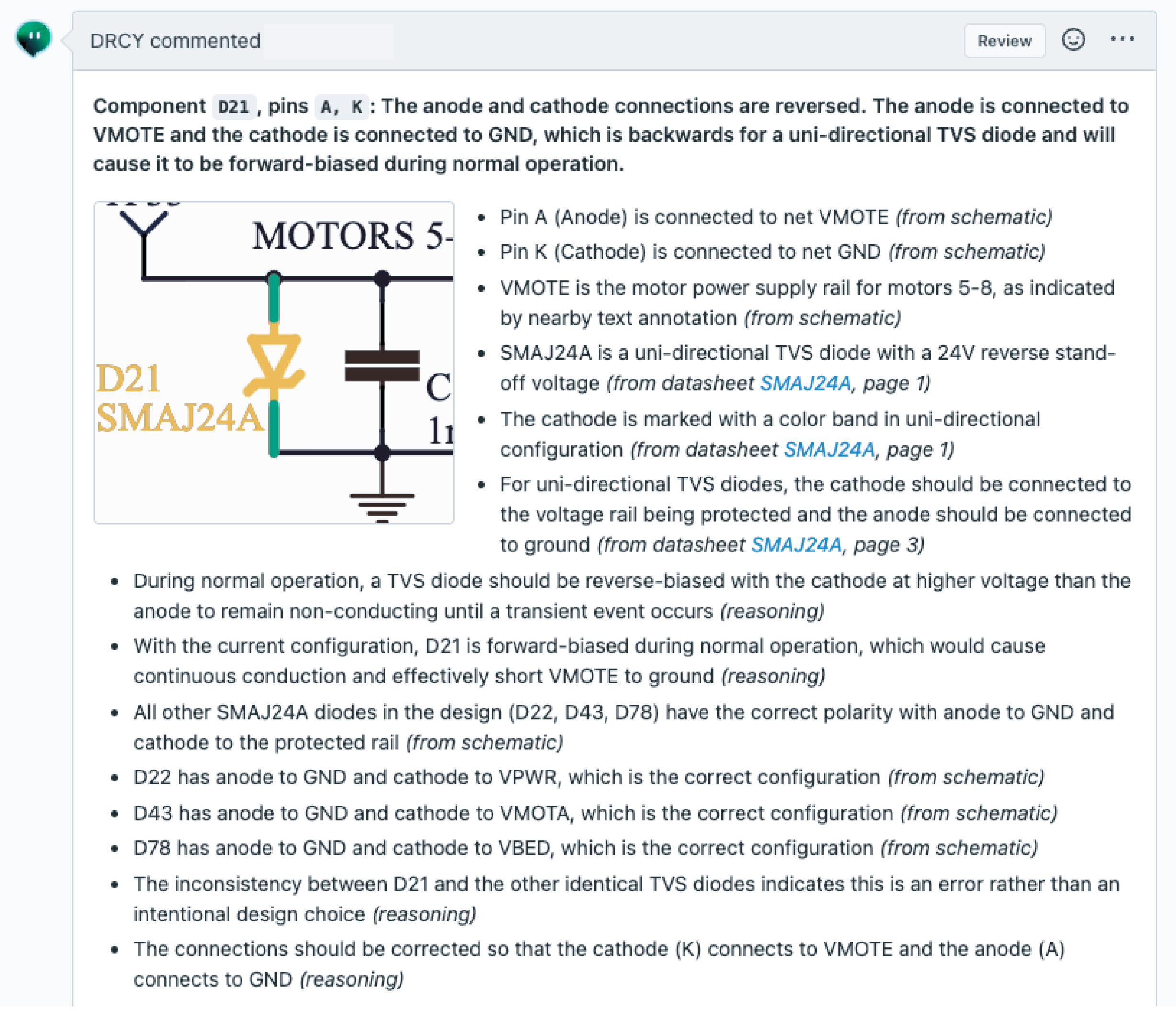
In the DRCY finding, the system flagged component `D21` and explained that the TVS diode’s anode and cathode were reversed. The anode was connected to `VMOTE` and the cathode was connected to `GND`, which would forward-bias the diode during normal operation instead of leaving it reverse-biased until an overvoltage event.
What makes this example especially strong is that the reasoning is easy to follow. DRCY does not stop at “this looks wrong.” It shows the evidence step by step:
- It identifies the actual pin-to-net connections from the schematic
- It references the part type and expected TVS behavior from the datasheet
- It compares `D21` against similar protection diodes elsewhere in the design
- It explains the intended configuration for this kind of rail protection circuit
- It recommends the correction: cathode to `VMOTE`, anode to `GND`
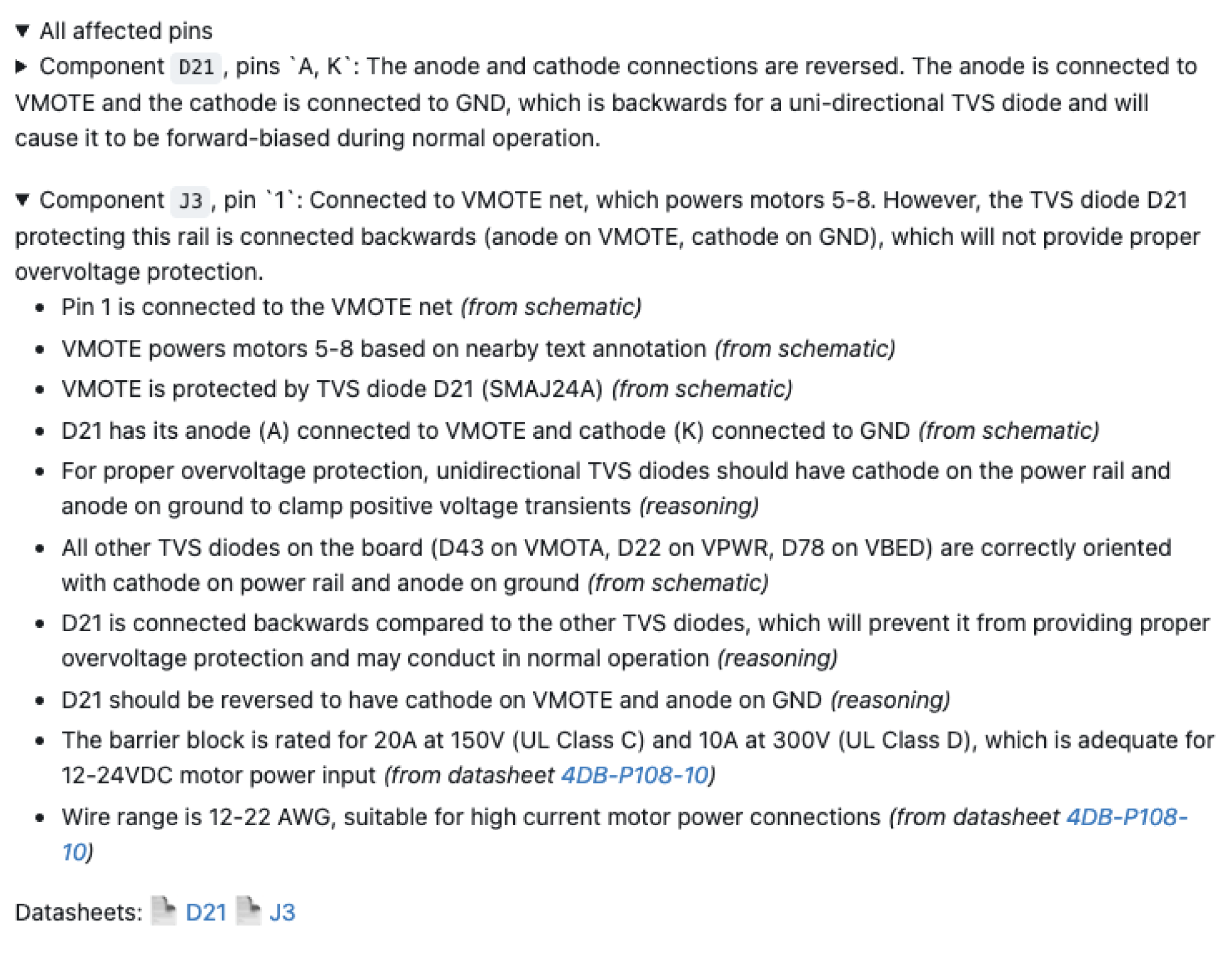
That traceability matters. An engineer can see not just the conclusion, but how the system arrived there and which facts support it. That makes the finding faster to validate and easier to trust. What makes this kind of finding useful is that power and grounding issues often look deceptively small in the schematic itself.
- The symbol may be present and appear correctly placed in the circuit.
- The protection intent may be obvious, even though the polarity is wrong.
- The real consequence may not become obvious until validation, EMC work, or bring-up.
By surfacing both the issue and the reasoning behind it, DRCY gives the reviewer a much clearer place to start. An engineer can quickly confirm the polarity error, correct the connection, and restore the intended protection behavior before the design moves further downstream.
Why it matters
Power issues can show up later as unstable behavior, reset problems, noise concerns, or long bring-up sessions spent validating something that should have been trustworthy earlier in the process.
How AI-assisted reviews help
AI can examine power-related structures across the full schematic, look for unusual patterns, and help verify whether a regulator or rail configuration aligns with the expected design intent and supporting datasheet information. This does not replace careful engineering review. It gives teams broader first-pass coverage when human attention is limited. The next layer of risk often sits in the assumptions built into the design libraries themselves. Those issues can remain invisible for quite a while, especially when the design otherwise appears sound.