Smarter hardware, fewer re-spins.
Design reviews do not fail because engineers stop caring. They fail because schedules tighten, designs grow more complex, and the small issues that matter most get buried in the noise. This guide looks at five schematic issues engineering teams often miss under schedule pressure, why they slip through manual review, and how AI-assisted review can help surface them earlier for engineer validation.
An AI guide for electrical engineers and engineering leaders
The new reality of hardware development
Design reviews are supposed to create confidence. They’re the moment where a team slows down, looks carefully, and decides a schematic is ready to move forward. If the review is solid, layout goes more smoothly, bring-up is less chaotic, and downstream teams spend less time untangling avoidable mistakes.
That is the ideal.
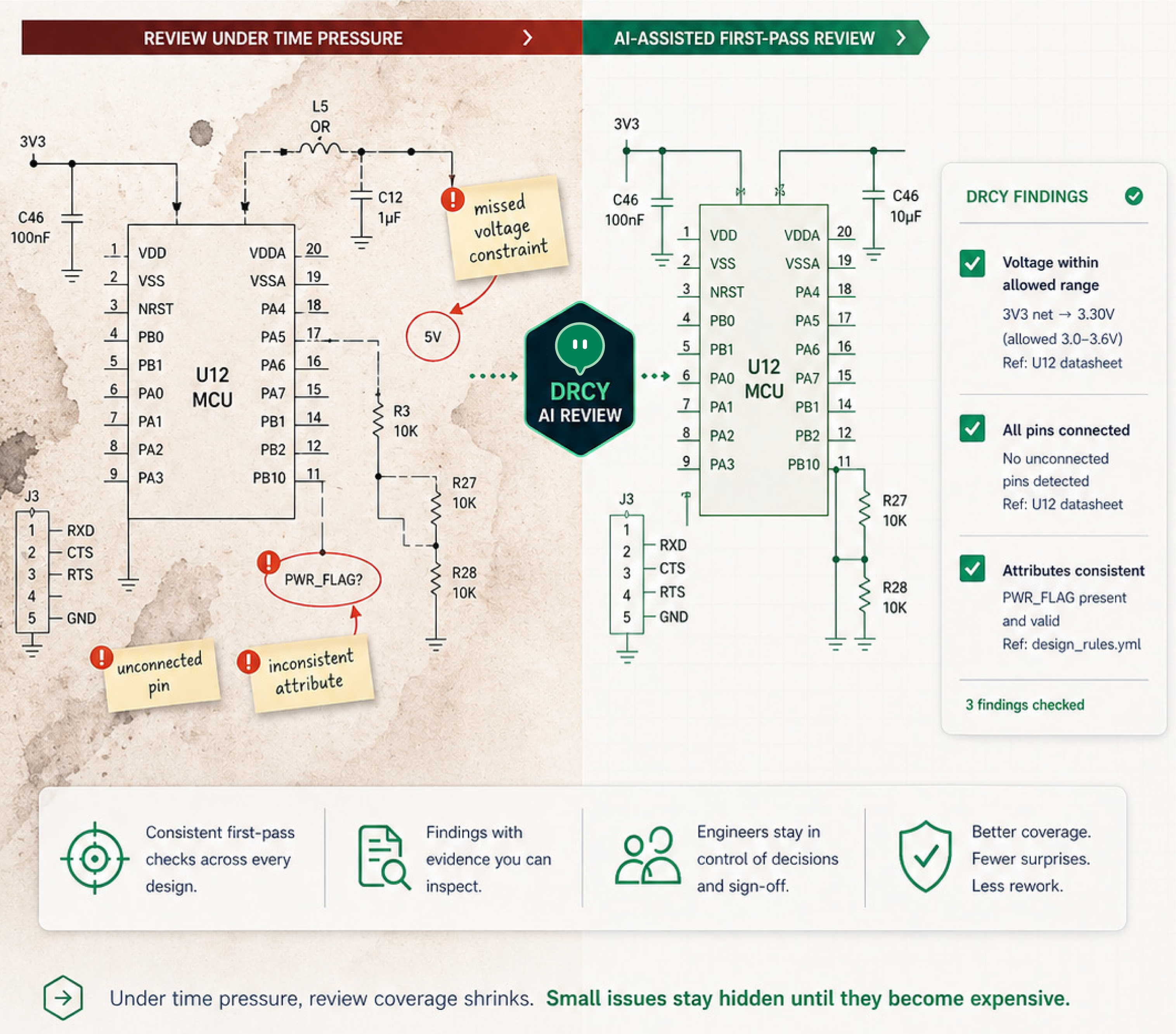
In practice, most hardware teams are reviewing under pressure. Deadlines are tight. Product complexity keeps rising. Senior engineers are spread thin. A schematic that deserves deep attention often gets a fast pass because the project has to keep moving. That does not mean the team is careless. It means the work is hard. Even strong engineers miss things when they are switching contexts, reviewing dense multi-page designs, and trying to cross-check pins, rails, attributes, package data, and revision changes from memory. This is where AI-assisted schematic review can help. Used well, AI does not replace engineering judgment. It adds a consistent first pass that can surface repeatable risks before they become layout churn, bring-up delays, or costly board respins. It gives engineers a clearer place to focus their attention and gives managers more confidence that important checks are not being skipped when schedules tighten.
This ebook covers five schematic issues that commonly slip through under time pressure, why they are easy to miss, and how AI design review tools such as Allspice DRCY can help teams catch them earlier.
Quick takeaway for managers
- Many downstream hardware delays began as small schematic issues that were easy to miss in review.
- Manual reviews are still essential, but they become less consistent under schedule pressure.
- AI-assisted design review helps teams perform repeatable checks with broader coverage and better traceability.
- Engineers stay in control of decisions, spending less time rechecking basic but necessary tasks.
Why schematic review gets harder as products get more complex
If your team designs modern electronics, this probably feels familiar. One engineer is finalizing a power tree while another is updating interfaces for a late component change. A reviewer is checking multiple pages of circuitry between meetings. Someone is also trying to clean up attributes for procurement. At the same time, the schedule is pushing everyone toward the next milestone. Under those conditions, reviews often become a mix of expertise, intuition, and time-boxed pattern recognition. That works better than it sounds, especially on experienced teams. But it still leaves gaps.
What schematic reviews are meant to confirm
A good schematic review usually tries to answer questions like:
- Are components connected the way the design intends?
- Does the power architecture make sense across the whole system?
- Are part selections, package choices, and supporting metadata aligned?
- Are there changes between revisions that introduce new electrical risk?
- Is the design documented clearly enough for layout, procurement, manufacturing, and test?
What usually gets in the way
Several very normal realities make manual review less reliable than teams would like:
- Large schematics are difficult to inspect line by line without fatigue.
- Similar circuit blocks encourage reviewers to assume patterns are repeated correctly.
- Important context is split across schematics, datasheets, BOM fields, libraries, and revision history.
- Late-stage reviews are often compressed to keep the schedule moving.
This is why the most expensive problems are often not unusual problems. More often, they are ordinary mistakes hiding in otherwise thoughtful designs. To see how that plays out in practice, it is worth starting with one of the most common examples.