Generate a capacitor derating report with DRCY Chat
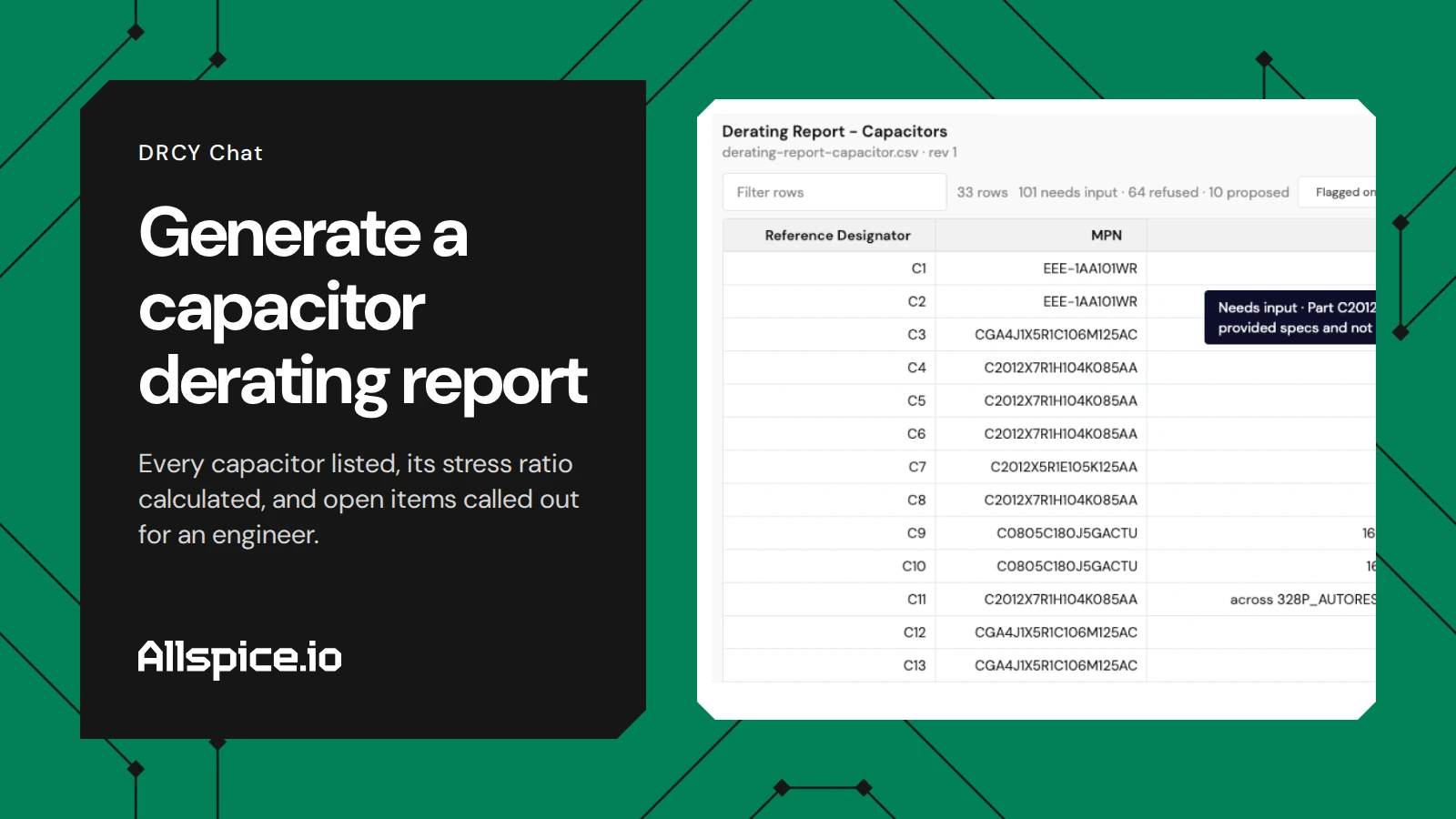
DRCY Chat turns a one-paragraph prompt into a traceable capacitor derating report, with every capacitor listed, its stress ratio calculated, and open items called out for an engineer to finish.
DRCY Review already gives your team an automated first-pass review on every design. It catches the common mistakes that slip through: a missing pull-up resistor, an incorrect capacitor, swapped pins, or swapped nets. But some questions need a deeper, targeted look. That's where DRCY Chat comes in. You ask for a specific analysis, and DRCY builds a custom report from your schematics.
In this post, we'll walk through one popular example: generating a capacitor derating report from your schematics.
Watch the walkthrough
Prefer to read? The steps below follow the video.
Why capacitor derating matters
A capacitor run too close to its voltage rating is a reliability risk. Derating means comparing the worst-case voltage a part actually sees against what it's rated for, then checking that ratio against a limit for that capacitor type.
Doing this by hand means walking every capacitor on every sheet, tracing its net, and filling in a spreadsheet. It's tedious, easy to get wrong, and often skipped until late in the design. DRCY Chat does the first pass for you.
How it works
1. Write the prompt
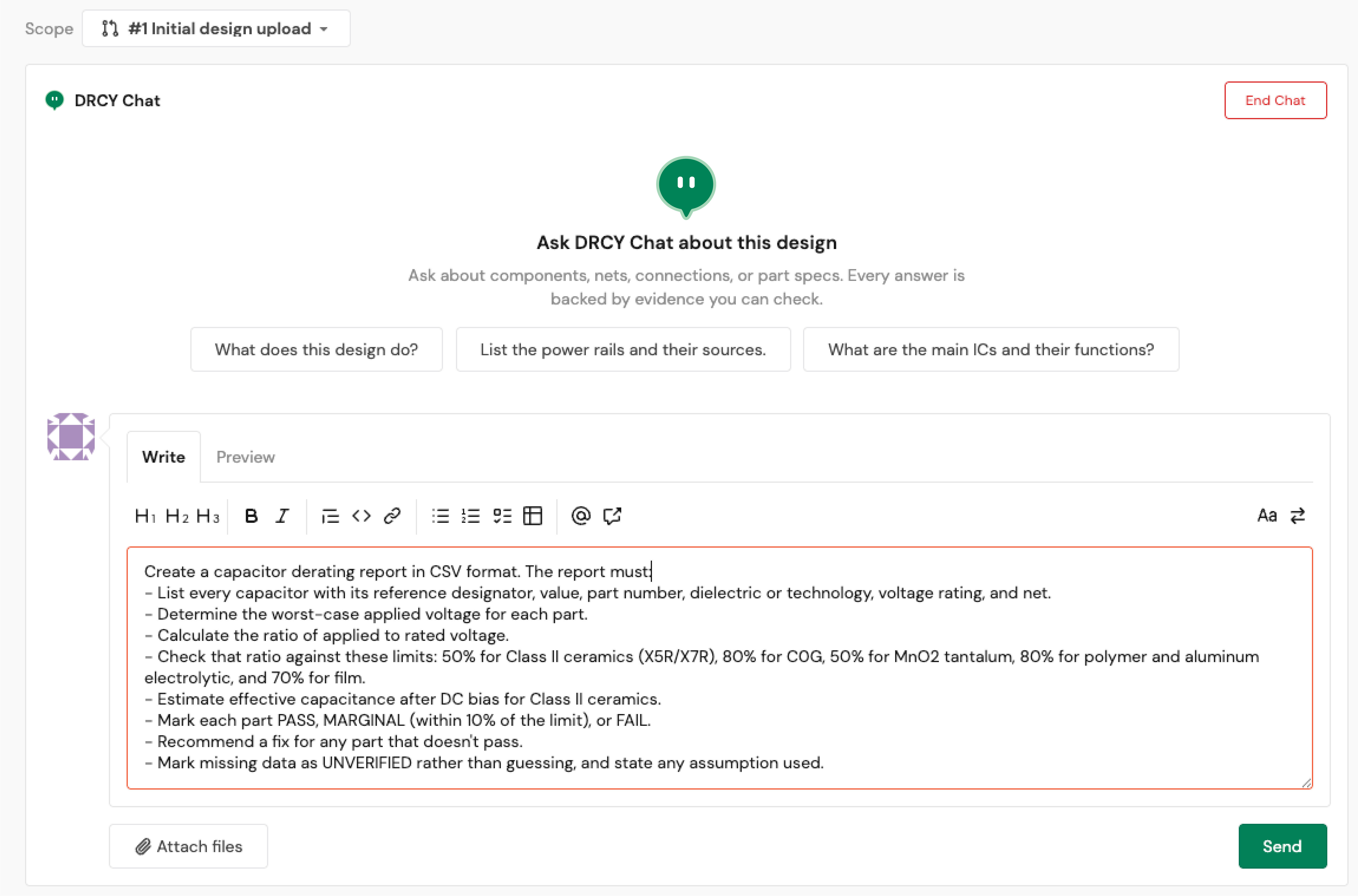
Open DRCY Chat choose what it should look at for context. You can point it at a branch, a specific design review, or a DRCY.md file in your repo. The scope keeps the analysis focused on the design context you care about.
Then describe the report you want in plain language. Our prompt asks DRCY to list every capacitor, find its worst-case applied voltage, and check the applied-to-rated ratio against the derating limit for its type.
Get our prompt
Create a capacitor derating report in CSV format. The report must:
- List every capacitor with its reference designator, value, part number, dielectric or technology, voltage rating, and net.
- Determine the worst-case applied voltage for each part.
- Calculate the ratio of applied to rated voltage.
- Check that ratio against these limits: 50% for Class II ceramics (X5R/X7R), 80% for C0G, 50% for MnO2 tantalum, 80% for polymer and aluminum electrolytic, and 70% for film.
- Estimate effective capacitance after DC bias for Class II ceramics.
- Mark each part PASS, MARGINAL (within 10% of the limit), or FAIL.
- Recommend a fix for any part that doesn't pass.
- Mark missing data as UNVERIFIED rather than guessing, and state any assumption used.
2. Let DRCY build the report
Send the prompt. As DRCY works, you can see the tools and skills it calls to pull data from the schematics and build out the report.
3. Review the results
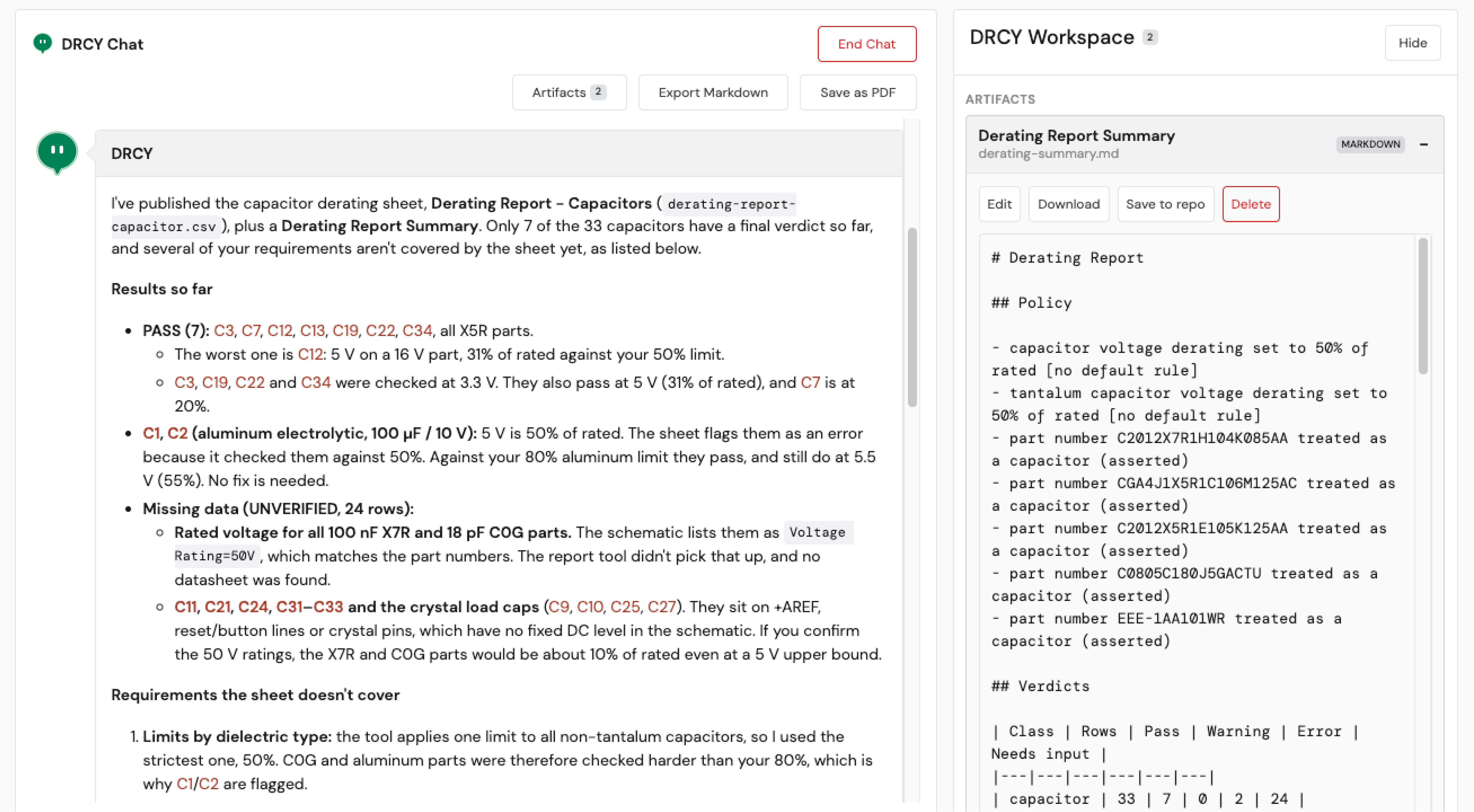
When it's done, DRCY gives you a summary of what the report contains. It also highlights limitations, identifies gaps, and cites the evidence behind its findings. You know what was checked and what still needs a human look.
From there you can open the report in a workspace, add it to the repo, or download it and edit it yourself and continue iterating.
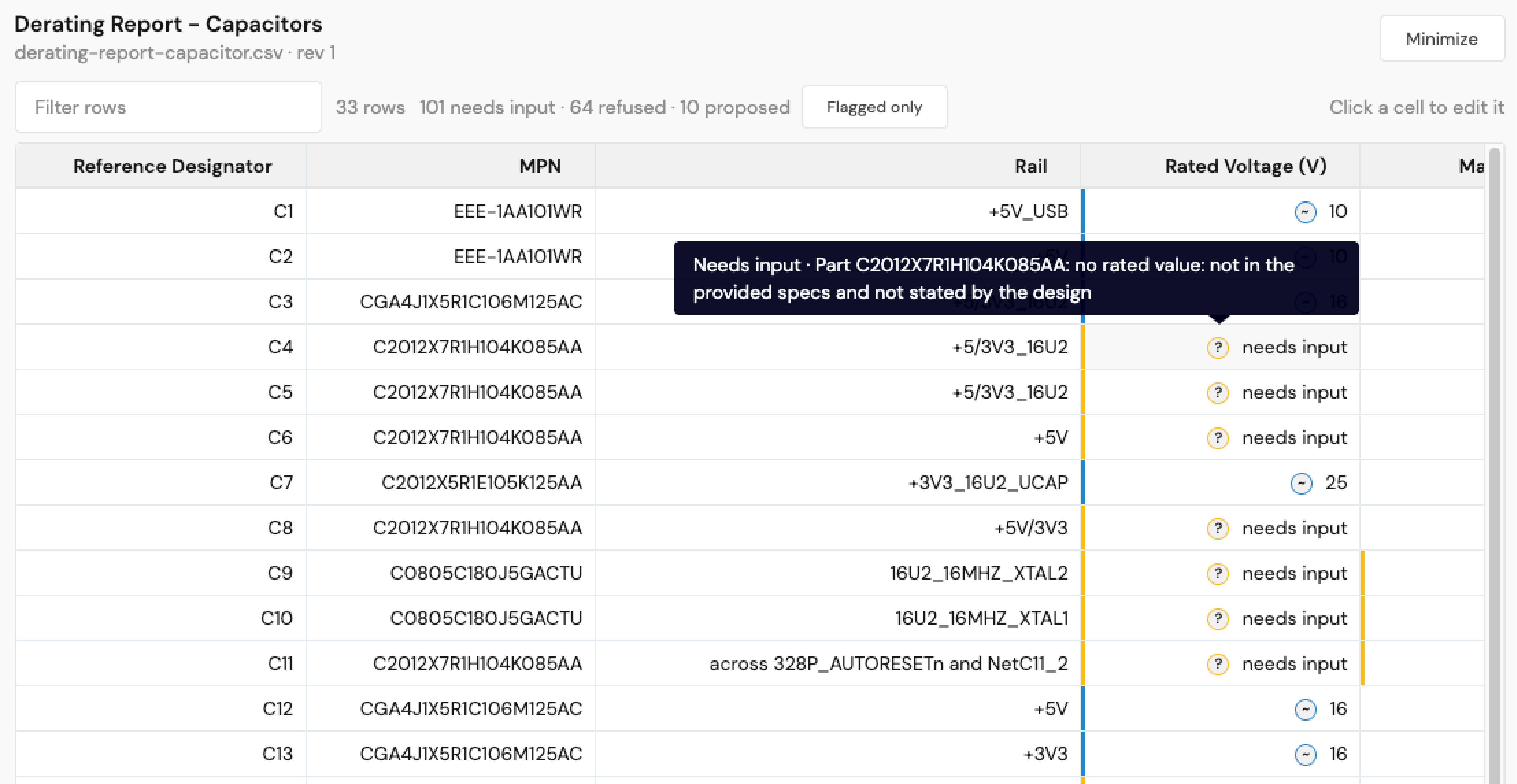
4. Ask a follow-up
The report is a starting point, not the end of the conversation. In the video, we ask DRCY for a quick summary of the highest-risk components. DRCY flags the capacitors with the worst stress ratio by a wide margin, along with a few other risk characteristics.
Beyond derating
In a couple of minutes, DRCY Chat went from a prompt to a traceable report with open items called out, ready for an engineer to finish and share. Derating is just one example. The same approach works for any targeted analysis your team would otherwise build by hand.