Revision changes that carry more risk than they seem
Many review problems do not come from the original design. They come from changes. An update may be small on paper. A pin is reassigned. A component variant is swapped. A net is rerouted to support another subsystem. The edit looks manageable, but its electrical implications are broader than they first appear.
Why revision review is difficult
Reviewers are often looking at a mix of visual differences, memory, and intent. They may understand that something changed without fully seeing what that change means across the design. This gets harder as projects grow and more people contribute across revisions.
What can slip through
- Regressions introduced by a quick fix
- Behavior changes caused by a swapped part variant
- Connection updates that have knock-on effects elsewhere
- Late-stage modifications that did not receive the same depth of review as the original block
A drain pin moved onto the wrong net
One useful example is a switching circuit where a single net-level change leaves the design looking mostly intact, but changes how the circuit behaves. In this DRCY finding, the system flagged component `Q13B` and explained that pin `5`, the drain, was connected directly to `VFAN` instead of to the switched output node. The review then traced that conclusion through the MOSFET’s role in a low-side switching configuration, comparisons to similar channels elsewhere in the design, and the surrounding fan-control topology. That makes it a strong fit for revision risk because this is exactly the sort of change that can slip through when someone is reviewing deltas instead of re-evaluating the whole circuit. The edit may look small. The symbol is still present. The control structure still looks familiar. But the electrical consequence is completely different: instead of switching the fan load correctly, the current connection would short `VFAN` to ground when the MOSFET turns on.
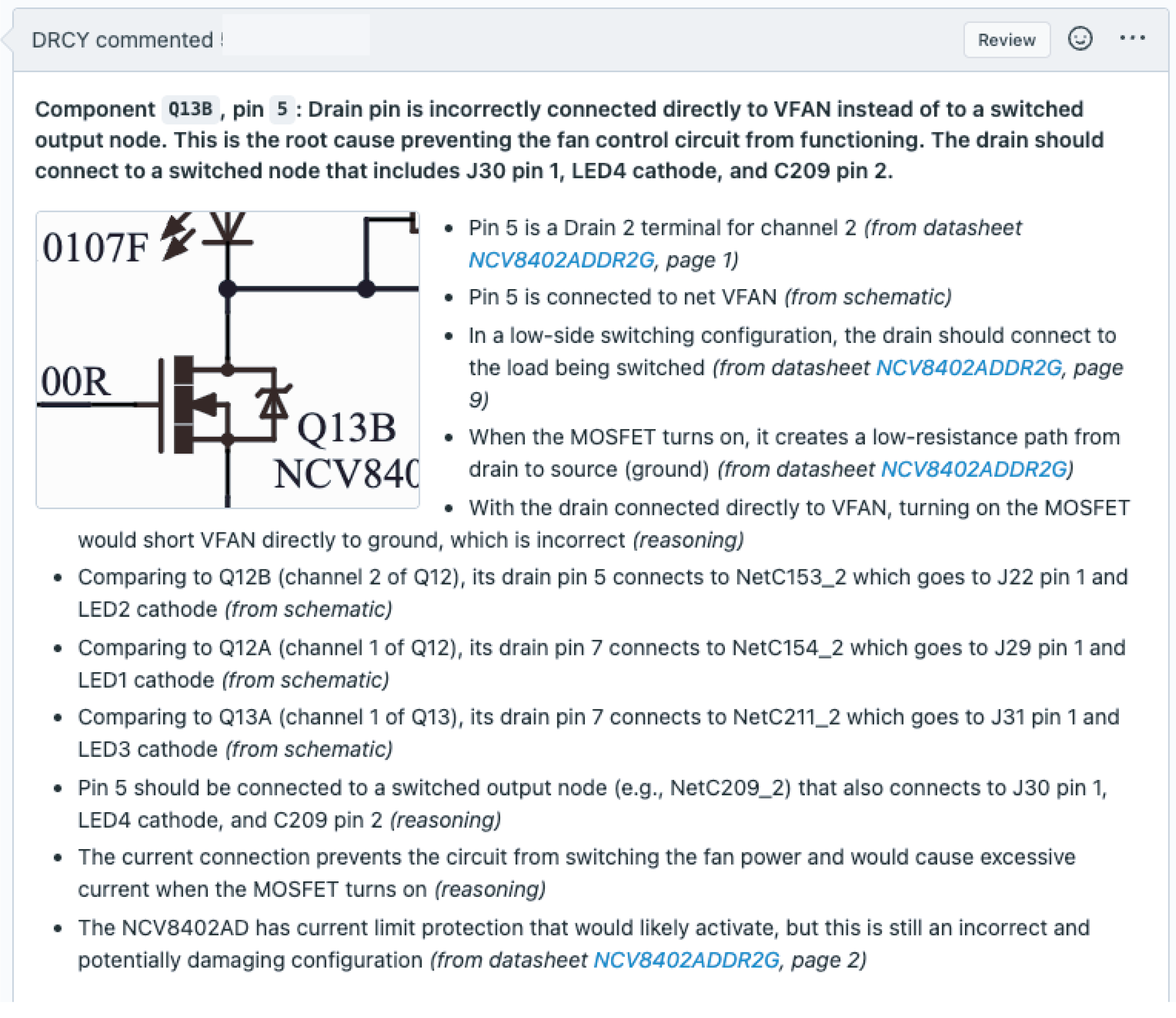
What makes the finding especially useful is that the reasoning is traceable
- DRCY identifies the drain pin and the net it is actually connected to.
- It references the expected drain behavior for the MOSFET topology.
- It compares the connection against neighboring, correctly wired channels.
- It names the switched node the drain should connect to instead.
- It explains the likely functional consequence of leaving the connection as-is.
That gives the reviewer more than a warning. It gives them a defensible explanation for why the change is risky and what should be corrected before signoff.
How AI-assisted reviews help
AI can compare revisions with more structure than a simple visual diff and highlight changes that may affect function, connectivity, or review risk. That gives engineers a better starting point for signoff and helps managers reduce surprises in later validation stages.
What changes when AI supports the review process
The value of AI in hardware design is not that it makes engineering automatic. The value is that it helps teams review more consistently when complexity and deadlines make consistency hard.
Before AI-assisted design review
Teams often rely on
- Manual inspection
- Reviewer memory
- Spreadsheets or ad hoc checklists
- Fragmented context across multiple tools
That approach can still work, especially with experienced engineers. But the coverage changes from review to review depending on time, load, and who is available.
With AI-assisted design review
Teams gain
- Repeatable first-pass checks
- Broader visibility across design context
- Earlier surfacing of review risks
- Traceable findings that engineers can inspect and validate
The engineer remains the decision-maker. AI simply helps make the review process more thorough, more auditable, and easier to scale.